Showing posts with label BioShock. Show all posts

Wednesday, April 3, 2013

BioShock Infinite Review

You have no idea...
NOTE: SPOILERS FOR ALL THREE BIOSHOCK GAMES FOLLOW.

Way back in summer 2011, I posted an article in which I discussed the current state of the BioShock video game franchise, expressing my love for the first and general ambivalence for the second. Irrational Games' original vision of the underwater city of Rapture remains one of the most captivating video game experiences of all time, and its 2K Marin-developed sequel, while fun and worth playing, amounts to little more than a tack-on. However, a few months after the release of the aforementioned BioShock 2, Irrational announced that their secret project, formerly codenamed Icarus, was in fact the next installment of the franchise, titled BioShock Infinite. However, it eschewed the concept of what a sequel usually is, trading in a well-worn retread of Rapture for the high-flying sky-city of Columbia, and jettisoning most of the franchises' most iconic features, from the city itself, to Big Daddies, to Little Sisters, to Splicers. Game director Ken Levine stated that while "the core" of what makes a BioShock game BioShock was still there, from the unfamiliar setting to the still-solid FPS/RPG hybrid gameplay. Plasmids became Vigors, Tonics became Gears, and EVE became Salts. And so, fans salivated for two and a half years, and a few delays, in anticipation of its release. Check to see of BioShock Infinite was worth the wait after the jump, and the requisite GIF:
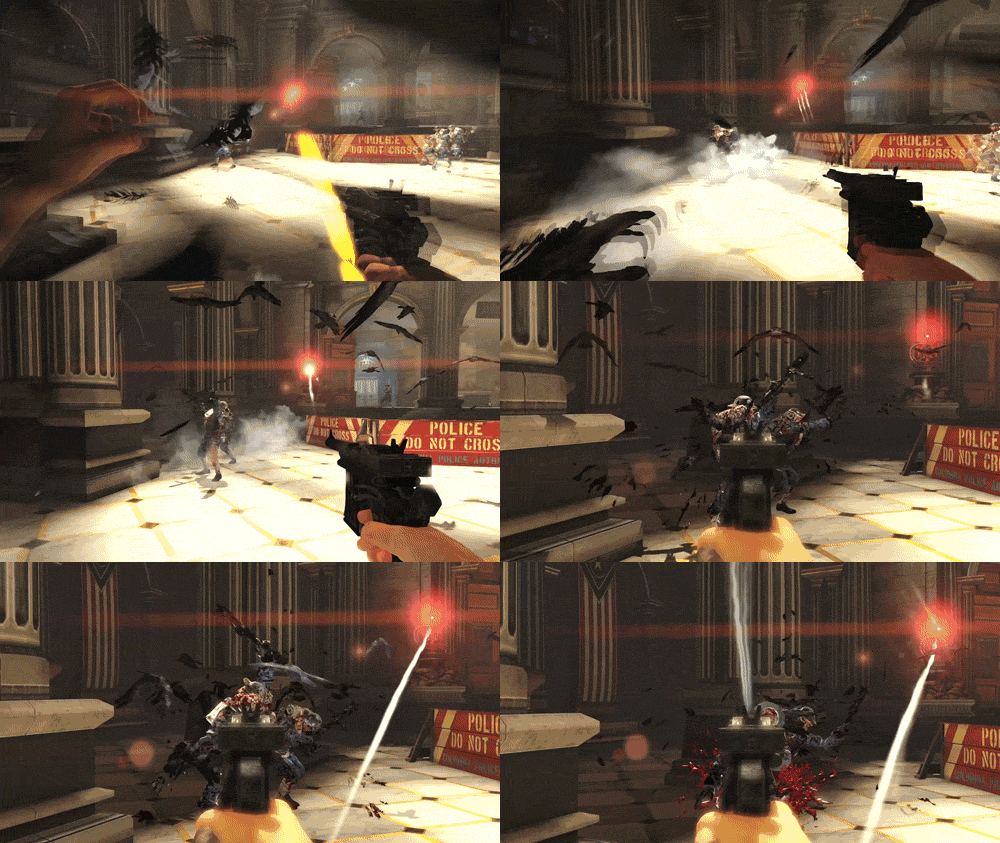
I. LOVE. MURDER OF CROWS.
BioShock Infinite is a masterpiece. There's no way of getting around that. Levine has created a game that ascends to the level of the original, and possibly soars above even that. It gives this series not only a shot in the arm, but it actually (and wonderfully) redefines what exactly this series truly is, from a narrative standpoint. The core gameplay is basically the same, with the same deal of shooting, powers, scrounging, collecting, and general mayhem. But it's in the story, the one area where BioShock 2 ulitmately fell flat, that Infinite truly rises to the occasion. On the initial surface, the story of ex-Pinkerton Booker DeWitt attempting to retrieve a girl, Elizabeth from the sky-city in order to clear some mysterious debts sounds simple enough, but as the plot progresses, the narrative becomes increasingly complex and labyrinthine, introducing Elizabeth's powers (the "tears"), the Songbird, the antagonist of the Prophet, Zachary Comstock, the Vox Populi resistance led by Daisy Fitzroy, and Booker's past. But when you think about it, nearly every single element of the plot has a direct comparison to the original BioShock. This is intentional on the part of Levine, as it allows him to truly get at the meat of his ideas. Jack, the outsider thrust into the mad, mad world of the city, is Booker. Comstock, the cultish leader who built the city due to his disagreement with the world's ideals, is Andrew Ryan. Daisy Fitzroy, the revolutionary who ultimately plays a role in the city's downfall, is Atlas/Fontaine. The Songbird is like one giant Big Daddy, with Elizabeth as his Little Sister. The Lutece twins are Dr. Tenenbaum.  To replace the threat of the Big Daddies as mini-bosses, we get the Handyman, and the Motorized Patriots. As Andrew Ryan conveyed his Objectivist ideals through his secluded underwater Art Deco metropolis, Comstock forces his hyper-fundamentalist and nationalistic cult (to a racist, insane fault) into every pore of his airborne Kensington. And just as in Rapture, not all in Columbia is as it seems.

For a large portion of my time spent with Infinite, I was essentially giddy with joy at the wonder that Levine had put in front of me. And yet, I felt like something, just SOMETHING was missing. I felt like that when I looked back on the game in future years, it would not be as indelibly printed on my brain as the original BioShock. Was Slate or Fink as memorable as the mini-bosses of Dr. Steinman and Sander Cohen? Was any area of Columbia as unforgettable as Rapture's terrifying Medical Pavilion? I was unsure; the only things that I felt would remain on my brain long after putting the controller down were Elizabeth, the Songbird, the Luteces, and Comstock. The only real wrinkle was the tears. I figured the game would have a neat twist at the end, a parallel to the still-gut-punching "would you kindly" twist from the original, probably to do with the tears. And I figured I would say it was great, but not as good as the original.

But I didn't get one game-ending twist. I didn't get two, or three, or four, or zero. I got, well, Infinite.

SPOILERS FOR THE ENDING FOLLOW.

So anyway, in the final act of the game, Booker drowns Comstock in his little baptismal pool/birdbath thing, and him and Elizabeth seize control of the Songbird in order to destroy the final threat of the Vox Populi, before finally leaving Columbia forever. They successfully utilize the Songbird's power to destroy their opposition, but then Booker loses the controls. Songbird immediately comes after him, forcing Elizabeth to transport them through a tear, to an entirely different place. Where, you ask? (LAST CHANCE TO AVOID SPOILERS)

Elizabeth rejected Columbia. Instead, she chose something different. She chose the impossible. She chose... RAPTURE.
That's right. Rapture. They took a tear into Rapture. At this point I practically exploded with pure fanboyism delight, as Booker and Elizabeth took the reverse out of Rapture in the bathysphere, the same way Jack came in in the original game. Booker makes a comment about the ridiculousness of an underwater city, and I explode with joy. And then, Twist #2 (or Twist #Infinite) arrives:

Ah. I get it now.
And thus, the true meaning of the title BioShock Infinite comes to the surface. Levine said he meant for it to refer to the "infinite possibilities" of the game concept. I thought that was dumb, because it meant that they were naming the second game in this high-concept idea Infinite when others may come afterwards. However, I now get that Levine's a game goddamn genius. Infinite really means that through every tear, every permutation of every possible universe, there are a million different BioShocks out there. A million different strange worlds, all entered through a lighthouse.

Um.

MIND BLOWN INFINITE TIMES
I see now what this is. Maybe Comstock was right, after all. Maybe this ending is divine retribution for the end of Mass Effect 3, which took a series with thematic depth and complexity equal (and possibly surpassing) the BioShock franchise, and then dumbed it down to a alien RoboBaby's choice of red/blue/green explosions.

And the thing is, there's still like, 20 minutes left in the game at this point, in which there are multiple more twists, one in the last 30 seconds of the game, all of which completely re-contextualize everything that came before. It's like infinite "would you kindly"s, back-to-back-to-back. None of them probably reach the single sheer brilliance of the original game's big twist, but unlike the original game, they all know how to follow up from there, whereas the original sort of lost its way in the final acts post-twist, culminating in an unnecessary Big Dumb Boss Fight.
This guy ain't half as threatening as one Big Daddy.
Sure, the ending(s) that came after that were great, iconic even, but Infinite doesn't trivialize. Rather than having you fisticuffs with an elderly Comstock, or having you fight the Songbird or something ridiculously implausible (like a guy ADAM-ing himself into mutant land like good old Atlas pictured above), they throw Columbia's kitchen sink at you, and force you to very quickly strategize your victory, leading to the utter NPH-mindblowing awesomeness described earlier. Also, the game has one, definitive ending. Levine was clearly more interested in a standalone story here than a morality play, and because Booker's ending is his own redemption in and of itself, multiple endings would muddle the impact.

So yeah, I liked this one. 2013 Game of the Year? Maybe, but it's a bit early for that. This year, after all, does also have The Last of Us, Grand Theft Auto V, and the launch of the next generation of consoles. Does BioShock Infinite hold up to the previous GOTY (IMHO) of this generation? Is it better than the original BioShock, Grand Theft Auto IV, Uncharted 2: Among Thieves, Mass Effect 2, Batman: Arkham City, or Telltale's The Walking Dead (which, again IMHO, is 100x better than the TV series)? Well, it certainly belongs in that pantheon. And it probably doesn't best Levine's original, if only because it cribs its entire gameplay framework from the former. Nevertheless, it's a game that EVERYONE should play, as with that ending, there's nothing quite like it.

BioShock Infinite gets full marks.

Meathead DudeBro pandering on one cover, pure art on the other.

Saturday, July 9, 2011

The BioShock Franchise

Objectivism, Collectivism, Jingoism. BioShock is a place of -isms.
Among video game franchises, BioShock is the one of the most visually and morally ambitious, under the watchful eye of Irrational Games creative director Ken Levine. And with BioShock Infinite, the third game in the franchise, about a year away from release, and a possible film adaptation in the works, I thought now would be the good time for a retrospective on the franchise.

Who's Yo Daddy?
The original 2007 game is one of the most visually stunning video games ever, with a deep and intricate mythology and even tighter gameplay. Regarded by many as a spiritual successor to Irrational's earlier effort System Shock 2, BioShock ranks among my favorite video games. From hunting Big Daddies and saving their Little Sisters to learning the tale of Andrew Ryan's creation of the underwater Objectivist society known as Rapture, it is one of the most emotionally involving games of all time. Therefore, when a sequel was announced in late 2008, color me excited.

Being a Big Daddy ain't as cool as it sounds.
BioShock 2, released in 2010, brought back most of the franchise's familiar elements, and gave a new protagonist in the form of one of the original Big Daddy prototypes, Subject Delta. Unfortunately, you never really feel like a Big Daddy, with a gameplay system that was almost exactly the same as the original. If you were another human, this wouldn't be a big deal, but as Delta, you fell just as easily as Jack would to weak Splicers in the first game. With a Rapture that lost its sense of wonder, to a Collectivist conflict in the story that felt awfully tacked on with its female antagonist (which paled in comparison to the original concept), to the greatly oversimplified yet ridiculously overpowered Big Sisters (the original concept featured just one as the main villain, and that idea was AWESOME), you'd have to wonder why the game feels like such a carbon copy of the original. And then you realize it's because the game was developed by 2K Marin, the people who ported the original game to the PS3, and the ambitious minds at Irrational were scarcely involved at all. Marin gave it their all, but BioShock 2, while being a fun and competent sequel (with a strong final act), just couldn't live up to the original. A new direction was clearly needed.

I'm a little bit country......
Then in August 2010, that new direction arrived, as Irrational Games' "Project Icarus" was revealed to, in fact, be BioShock Infinite. With a new city (the sky-city of Columbia), new powers, a new story, and a new mythology overall, this looks to be the franchise's shot in the arm. Booker DeWitt is no Jack or Subject Delta, having a face and a voice, and a clear objective, that being to rescue Elizabeth, a girl being held captive inside the sky city. Elizabeth has some interesting powers, that Ken Levine refers to as "tears", which allow her to alter reality, while Booker gains powers called Vigors (this game's Plasmids). While Infinite retains some of the old game's concepts, a new setting seems to be what Levine always intended. This could be one for the ages.

As for the film adaptation, it currently appears to be in limbo. Gore Verbinski of the Pirates of the Caribbean series is attached as a producer, while Juan Carlos Fresnadillo of 28 Weeks Later was last set to direct. While 2K Games is still committed to the project, Verbinski says the funding has dried up. I hope this gets made as was intended, but that seems unlikely now.

BioShock Infinite is currently scheduled to be released in the second quarter of 2012.
The BioShock film's release date is unknown.

Star ratings for the first two games:
BioShock - 5/5
BioShock 2 - 3.5/5