Showing posts with label Sherlock. Show all posts

Thursday, June 14, 2012

A Tale of Two Sherlocks - Part II

Conspiracies, detectives, exploding woods, and Moriarties
Looking back down my blog history, one might recall a compare/contrast post I did almost a year ago now, called A Tale of Two Sherlocks, that discussed the casting, premise, and execution of two very different adaptations of the original works of Sir Arthur Conan Doyle, one which moved into a modern setting yet stayed truer to the stories, whereas the other kept the Victorian setting, but went for a more bombastic, stylish to the point of steampunk, Hollywoodized action-fest that still managed to be well-characterized and entertaining. And now, having seen the second series of the Steven Moffat-headed BBC series Sherlock, as well as the Guy Ritchie sequel Sherlock Holmes: A Game of Shadows, I have returned once again, this time to evaluate the second act of these respective stories. Again, I feel I must reiterate that I believe Jeremy Brett's Holmes is THE definitive version of the character. Period. Robert Downey Jr. and Benedict Cumberbatch are terrific actors, to be sure, but they don't exude the exact quality that made Brett feel like Doyle's creation straight off the page. Anyways, on we go. This time, I'll do Sherlock first:
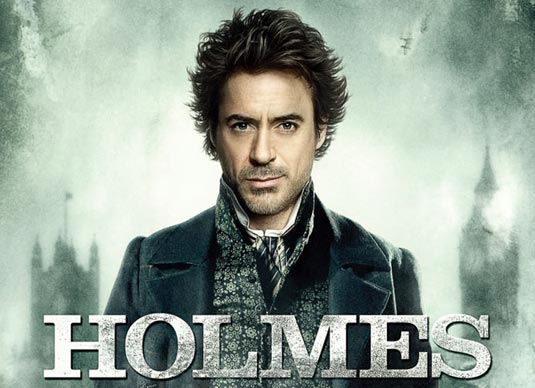
Joker ain't got nothing on me.
Sherlock basically continues onward, exactly as you would expect, for the first two episodes of Moffat's second series. I found "A Scandal in Belgravia" (Of course, a riff on the classic "A Scandal in Bohemia" tale from Doyle's canon) to be somewhat of a disappointing first installment, quickly brushing aside Moriarty and the explosive (LOL) bomb jacket cliffhanger from Series 1's "The Great Game" in favor of a side story loosely connected to the Moriarty story, but mostly a standalone tale, featuring the most vanilla incarnation of Irene Adler ever. Certainly, Lara Pulver does an admirable job with the material given, and shows some fearlessness in certain scenes (the nude sequence surprisingly served a purpose, to throw Holmes off his game), but the character ends up feeling like a mere underling/pawn between Holmes and Moriarty, and lacks the general femme fatale feel that Rachel McAdams brought to the role so ably in Ritchie's film. It succeeded in moving the story forward, and I enjoyed the meta elements (mentioning various Holmes cases while also referencing the deerstalker's cap and other Holmes iconography), but the Adler elements were disappointingly lacking. Thankfully, this was quickly rectified in the second episode, a standalone, but Moffat's take on one of the best Holmes stories, that being "The Hounds of Baskerville". Many critics hated this one, criticizing it for its placement, similar to last season's "The Blind Banker", but I personally thought that it was fantastic, sufficing as an imaginative modern spin on the classic "Hound of the Baskervilles", while giving us some excellent Holmes-Watson face time. Did I mention that Benedict Cumberbatch and Martin Freeman continue to excel in their roles? No? Well, they both seamlessly carry over from the first series, perfectly modernizing the classic duo while staying true to the characters of the original stories. However, they, as well as Andrew Scott as Moriarty, take it to a whole new level in the virtuosic finale, "The Reichenbach Fall". It perfectly turns the entire series (and I mean all 6 episodes) completely on their heads, making us question all of the events thus far, as well as Holmes' integrity, and Moriarty's true identity, leading to a frankly trascendent climactic scene where Moriarty is revealed to be the orchestrator of all the events. Scott strays pretty far from the source material in his manic, mood-swinging Machiavelli, but creates a whole new interpretation all the same, owing just as much to Heath Ledger's Joker as he does Doyle's character. It is also the later scenes of "The Reichenbach Fall" where Cumberbatch and Freeman are at their best, bringing levels of heightened emotion to their characters, and leaving us with one heart-wrenching hell of a cliffhanger. It's hard to tell where Sherlock will go now (other than at least part of the first episode of series 3 adapting "The Empty House"), but I have confidence in Moffat, Cumberbatch, and Freeman, and we'll see what happens. Now, on to Ritchie's own Moriarty-infused sequel, Sherlock Holmes: A Game of Shadows:

It takes a lot to match wits with Tony Stark

Many have lambasted A Game of Shadows as Ritchie and screenwriters Kieran and Michele Mulroney ignoring what made his take on Holmes work last time, relying instead on noisy action sequences and an overly complicated mystery plot. However, I feel that it's a pretty logical extension of what Ritchie set out to do the first time around, and especially in light of the arrival of the BBC series, it was wise to take the sequel further in the action direction. It allows the film to still be tied to Doyle's stories without ruining them, and presenting a fresh, slick, and exciting take on the proceedings of Doyle's "The Final Problem", complete with gypsies, much witty Holmes-Watson banter, and ACTUAL Reichenbach Falls for Holmes and Moriarty to grapple over. It is disappointing, however, that Rachel McAdams' role had to be cut short. Noomi Rapace does the best she can, but Simza is simply a plot device, not a character, and Irene Adler could have organically worked in the role as well. They also really underused Jared Harris as Moriarty, who isn't as central as his role in the plot should suggest he be. It's even more disappointing when you see how good Harris is in the role. As good as Scott is on Sherlock, his character isn't really like the character written in Doyle's stories, instead going for a more manic take in "Jim Moriarty". Harris, on the other hand, is a dead ringer for the iconic professor. From talking about how Holmes has been "disrupting" and "meddling" in his plans, to matching wits with the detective every step of the way, to his almost banal, gentlemanlike manner with just a hint of the rage boiling underneath occasionally escaping to the surface, I am so happy they cast for quality rather than big names (Brad Pitt and Daniel Day-Lewis, great actors though they are, wouldn't have been good fits). Anyone who's seen Fringe or Mad Men can attest to Harris' aristocratic style, and Fringe definitely sells his ability to go all Hannibal Lecter on people. And he brings this to Moriarty, making for an ideal antagonist to the bonkers, bohemian character that is Downey's Holmes. Downey still exudes charisma, even if he's still not a perfect take on the detective, and Law is still a capable and sardonic Watson. Ritchie's direction improves, and while the script may have some problems, I think that A Game of Shadows matches its predecessor time and time again.

So, in conclusion, the second series of Sherlock does best the movie, but not by as much as you'd think. I implore for people to think of them separately rather than competing, and would hope everyone can enjoy both. Sherlock offers a deeper, more deductive take with a far more insane and personal villain, while A Game of Shadows offers a fun, big-budget, popcorn style adventure with far higher stakes for the world at large. Just watch both. You probably won't be disappointed with either, as long as you go in with the right mindset.

Sherlock Series 2:
"A Scandal in Belgravia" - 7/10
"The Hounds of Baskerville" - 9/10
"The Reichenbach Fall" - 10/10

Sherlock Holmes: A Game of Shadows - 8/10

You said it, Jim.

Wednesday, July 6, 2011

A Tale of Two Sherlocks

Iron Man and the Sky Captain vs. William Pitt and Tim Canterbury
Ah, Sherlock Holmes. Master detective, the ultimate sleuth, an analytical, emotionless man unlike any other, the ultimate and iconic creation of Sir Arthur Conan Doyle. This article is, mainly, about the two current depictions of him in film and television form, those being Guy Ritchie's Sherlock Holmes film series (the original 2009 film and the upcoming sequel, A Game of Shadows), and Steven Moffat and and Mark Gatiss' contemporary BBC TV series Sherlock. In terms of the depictions of the titular character, I will not argue whether one of them is "the best Holmes ever", as the late Jeremy Brett, of the Granada TV series The Adventures of Sherlock Holmes from 1984 to 1994, is unequivocally the best, period. Brett was the actor born to play the role, and it is unlikely anyone will ever surpass him. First up, the Ritchie films.

I need Irene Adler's pussy to power my Arc reactor.
The first film, 2009's aptly titled Sherlock Holmes, attempts (and mostly succeeds) to be a fresh new take on well-worn material. Combining elements of multiple Doyle stories and throwing a fresh new plot and antagonist into the mix, the film also sports a grand, Gothic visual style and strong, well-written characters played by well-cast actors. Out of all the roles, I'd say the best cast and acted was Jude Law as Watson. His version of the character is a younger, fitter, and stronger incarnation than those in past iterations, and he has a much more independent mindset as well. Unlike other versions, him and Holmes really seem like equals in terms of their friendship (as opposed to Holmes looking down to and condescending the intellectually inferior Watson, as in the past), and it makes for both a more humorous and emotional dynamic. In this movie, they really seem to need each other in their lives. However, this shouldn't discount the rest of this strong, strong cast. Rachel McAdams is good as Irene Adler, being just femme fatale enough to keep Holmes both enamored and on his toes with her. Mark Strong, as always, plays a very powerful and creepy villain as the occultist Lord Blackwood, his menace casting a shade over the whole movie. And finally, Robert Downey Jr. as the titular character, is.....not quite perfect. That's not to say he is bad (quite the contrary, he does the character justice and strives to bring something new to the table, despite his somewhat inconsistent accent); more that he just isn't quite the fit for the character. This incarnation would have benefited from a younger Holmes (in a Batman Begins vein), played by someone like, for example, James McAvoy. Watson is older than Holmes in most versions anyway, so he could've worked with Law quite well. His performance in the recent X-Men: First Class shows that he has that touch of charisma needed, along with the ability to play a strong, analytical mind. Nevertheless, Downey is strong, and earned his Golden Globe (though I'm not quite sure why it was for Musical/Comedy). The real issue with this film that keeps it from being great instead of just good is the style. Ritchie's laid-back action style doesn't mesh well with Doyle's world, as Holmes has never been an action hero. The film is full of action sequences that simply don't need to be there. The disguise, street chases, and analyzing are necessary for the character, but the action is simply not needed (such as the fighting ring scene). A Game of Shadows, the sequel due out this Christmas, sees the return of Ritchie, Downey, Law, and McAdams (briefly, I've heard), as well as newcomers Noomi Rapace (the star of the Swedish Millennium Trilogy films) as some Gypsy named Sim, and Mad Men's Jared Harris as Holmes devious and deadly arch-nemesis, Professor Moriarty. It's rumored to be based on The Final Problem, the final Holmes story, so we'll se where that goes.

Big Ben = Holmes' wang when presented with a case
Sherlock, on the other hand, is quite a different beast. A 3-episode BBC television series developed by Doctor Who writers Steven Moffat and Mark Gatiss (with 3 more eps on the way this fall), this version sets Holmes and Watson in modern times, in 2010 London. Thus, Sherlock has a whole new set of quirks to go along with his old ones, such as only texting (never calling) with his cell phone, and lacking elementary knowledge of certain areas of study (such as astronomy), believing they cloud his brain from his detective work. This version tells the origin of Holmes and Watson, so their relationship develops at a slower and more natural pace than the film series, in which their association has been established for years. Thus, less emphasis is placed on them, and more on Holmes' obsession with his work. Many in modern days believe the man is crazy, and that he will inevitably snap one day and become one of the monsters that he currently pursues. Watson becomes the inside man on all of this, becoming Holmes' ally and medical expert, as well as the writer of his blog. This version introduces Moriarty very early as well, with his presence becoming known as of the end of the first episode and fully realized as of the end of the third. As for the cast, they are, for lack of a better word, outstanding, particularly Benedict Cumberbatch as Holmes. He may very well be the best Holmes since the late Brett, bringing all the mannerisms along with the perfect tone and train of thought. As for Watson, our future Hobbt, Martin Freeman is great as usual, playing the perfect kind of straight man that allows us to see Holmes through his eyes. Other than that, no real characters to speak of, except for Andrew Scott's brief, awesome appearance as the completely psychotic Moriarty, who sets up a really interesting dynamic between him and Holmes for the upcoming season. To individually rank the episodes themselves, I thought that the first one, "A Study in Pink", was really great at setting up the series while telling a fun standalone story, which made the second, "The Blind Banker", so disappointing. "Banker" felt like a good episode in a long running hour-length series, but in a season of only three 90-minute episodes, it was too little content overstretched over the length. Also, it had no developments on the Moriarty story arc, and virtually ignored the events of the first episode. But then, the final episode, "The Great Game" (reminiscent of the Game of Shadows film subtitle), was utterly spectacular, beating out the film adaptation in my opinion, with a gripping story and finale, as well as an even greater cliffhanger. I am waiting with bated breath for the second season.

Overall, I would so far grade the TV series as being the better adaptation, but the movie has very different merits of its own. I would argue Cumberbatch over Downey, a tie between Freeman and Law, a win for the movie's supporting cast, and a win for the show on design.

Sherlock Holmes: A Game of Shadows opens December 16.
Sherlock Season 2 premieres sometime in Fall 2011.
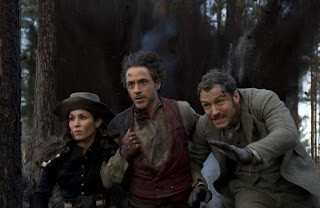
Do not fear me, Gypsy, all I want from you is your tears.


Star ratings:
Sherlock Holmes - 4/5 stars

Sherlock series-
"A Study in Pink" - 4.5/5 stars
"The Blind Banker" - 3/5 stars
"The Great Game" - 5/5 stars