Tuesday, June 26, 2012

Ranking Christopher Nolan's Movies .

With the release of my most (and from what I suspect, a SHIT-TON of everyone else) anticipated film of the year, The Dark Knight Rises, a mere three and a half weeks away from release, I figured now would be a good time to look back on the films of the man who made this gritty cinematic reinvention of the Dark Knight possible: Christopher Nolan.
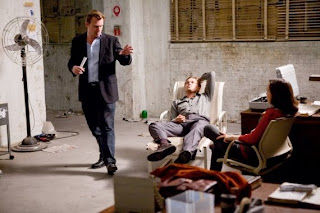
So, it's Chris Nolan, Billy Costigan, and Juno all in a room...
Along with David Fincher, Nolan is easily one of my favorite contemporary directors. An auteur with a vision all his own, Nolan has yet, in my opinion, to make a bad film. Rather, he's made seven films over the last 15 years that linger in varying degrees of "good" to "masterpiece" quality. I must admit that I have not seen Nolan's little indie debut, Following, as of now (but I plan to very, very soon, probably before TDKR is released), so I will cover his 6 most well-known pictures, ranking them from worst to best.

First, number 6:
Insomnia
Insomnia, Nolan's first movie working with a more mainstream cast, as well as the only film in his canon that is a remake (1997 Swedish movie) is definitely the worst of his six movies that I've seen, but by no means is it bad, or even less than good. Simply, it's the worst of the only because it's the most simple and straightforward, the one that doesn't really have much to say or show off. Rather, it's simply telling a story, one of a cop who, after accidentally killing his partner (with whom he was embroiled in a prickly Internal Affairs situation), becomes increasingly paranoid and wary while on the hunt for a serial killer, which is only made worse by both the killer's manipulations and the insomnia caused by both the moral unrest and the fact that the case is taking place in 24-hours-a-day lit Alaska. Despite its simplicity, and Nolan's rather workmanlike direction, the movie is driven by the commanding performances from its leads. Al Pacino gives his last really great performance on film to date as the insomniac detective Will Dormer, and Robin Williams gives a chillingly creepy turn as the killer, Walter Finch. Compared to Nolan's other deeper, labyrinthine films, Insomnia is rather simple and to-the-point; this makes it worthy of his body of work, but not as standout or memorable as his other movies.

5:
Well, read the banner.
The Prestige is also unique among Nolan's movies; where Insomnia was a remake, The Prestige was an adaptation of a novel by Christopher Priest, about two former magician friends who become embroiled in a bitter rivalry, in their quest to achieve the ultimate illusion. Where Insomnia was simple, The Prestige is deep and convoluted, a story of obsession and sacrifice in pursuit of an impossible dream. Truth be told, I love many things about this one; the only reason why it's so low on the list is because it suffers the opposite problem of Insomnia, in that its reach exceeds its grasp and it ultimately gets too damn convoluted. The movie has at least one too many plot twists, and the ending is somewhat disappointing in that it fails to provide a truly fair explanation. That being said, it's definitely an exciting and extremely fun flick worth watching, with Hugh Jackman, Christian Bale, and Michael Caine all delivering top-notch performances. It's also a beautifully shot period piece, with Wally Pfister's talent as a cinematographer never being more on display. It's also got a great and eclectic supporting cast, including Scarlett Johansson, Andy Serkis (in non-mocap form for once), Rebecca Hall, and get this, David freakin' Bowie as Nikola Goddamn Tesla. So, yeah, I'd say this one's pretty awesome, if a little too smart for its own good.

4:
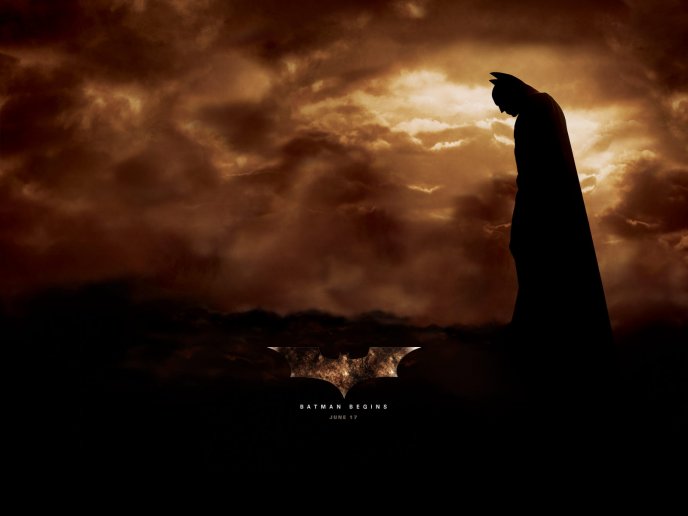
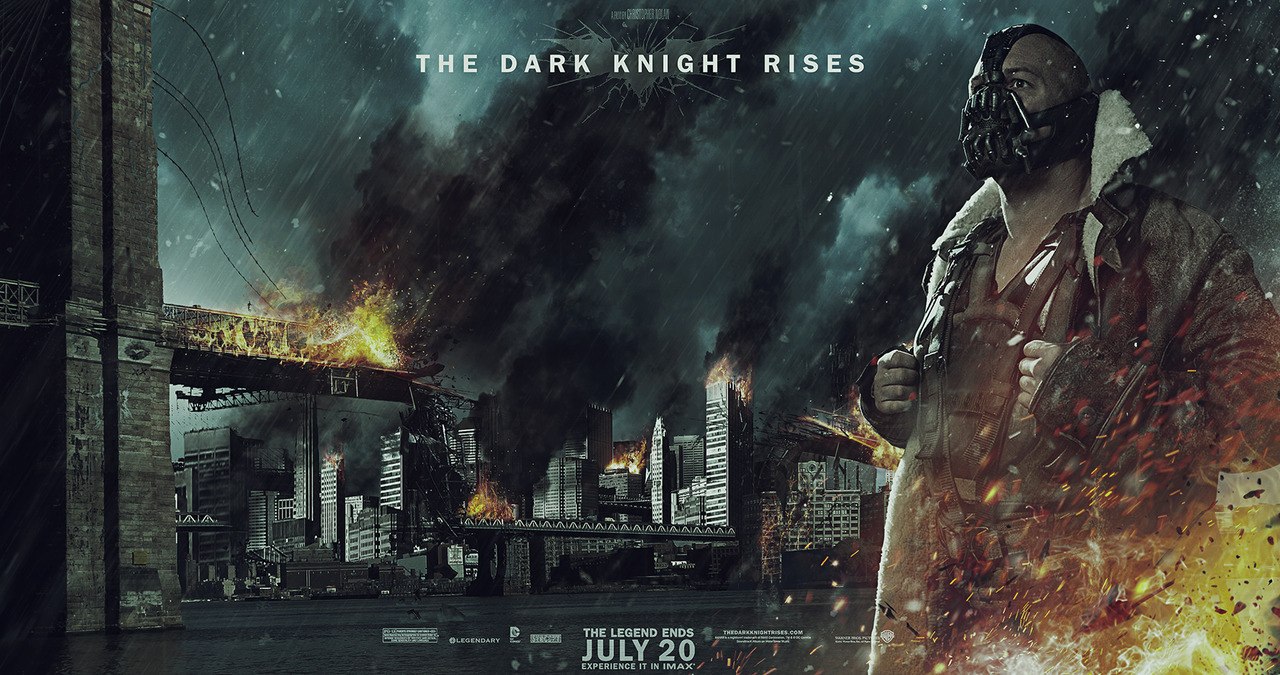
Why do we fall? So we can learn to Rise on July 20.
Batman Begins. So, at #4, we finally have reached a point in the list where I can begin to talk about Nolan's Batman trilogy. Batman Begins, as a guy who lived most of his childhood in the 2000s, was the first Nolan flick I saw, in the theater shortly after its release in June 2005. Batman had long been my favorite superhero, but as a non-comic book reader, I was unsure as to what I would think of a new interpretation of the character. Tim Burton's two Batman movies were stylish, freakish fun, mostly like Burton's other films, but they missed the character by a wide margin. Batman in Burton's eyes was a neurotic, sociopathic recluse who had no real moral code to speak of, nor a real mission or motive behind his actions. Schumacher's was even worse, taking Batman away from the treatment that he deserved back into horribly dated Adam West territory. Nolan finally brought the character back to cultural significance, by giving us a Bruce Wayne who, in a very intimate and human way, grows from the poor rich kid who's parents were murdered by a mugger, to the disgruntled and revenge-seeking young man, and finally, into the Caped Crusader. Bale really made us care for both sides of the character, as we finally were able to dig into on film who Batman was and what motivated him. In addition to Bale, we got Caine as Alfred, Liam Neeson as the mentor/villain, and Morgan Freeman as Batman's armorer. The only real faults of Begins were the somewhat inconsistent comic-booky elements (particularly the villain's evil plan), and the way the movie had difficulty transitioning from Batman's origin to his first obstacle. Oh, and Katie Holmes' acting. That probably knocked this shit down a peg all by itself.

T-3:

Do you want to take a leap of faith? Or become an actor in old-man makeup, filled with regret...
I was unable to decide between my #3 and #2 choices, so simply, they will be tied at 3rd, below #1. The first of these two is Nolan's most recent release, the mind-bending big-budget opus known as Inception. Upon its release, some (myself included) were singing the heavenly praises to this one, referring to it as Nolan's best, and one of the best ever as well. While that may have been slight hyperbole, Inception remains, even in repeat viewings, as a really goddamn awesome movie. The complexities of the plot may fall away in repeat viewings, revealing the straightforward action movie with a dream twist (as well as a few surprisingly well-timed emotional moments) underneath, that is still a fairly top-notch film in every sense of the word. Nolan's script juggles between dream worlds and realities seamlessly, bringing the dead, the living, and the imaginary together, ghosts of the past and hopes for the future all put together. Leonardo DiCaprio gives a strong performance as the lead, and Ellen Page, Joseph Gordon-Levitt, Ken Watanabe Tom Hardy, Michael Caine, and Marion Cotillard all excel as well in roles of varying screentime. Hans Zimmer's score is virtuosic, building on the style he established in Nolan's Bat-films, and Lee Smith's editing between dreamscapes is simply breathtaking. Inception may be a tad overrated, but it's still a great, great film, and definitely high up in Nolan's canon.

T-3:
Remember Sammy Jankis. And John G. And Teddy. And Natalie. All on tattoos and photos.
Tied with Inception on my list is Nolan's breakout film, and probably the one most indicative of his directorial talent, Memento. Much like Inception, Memento stages a totally awesome and insane juggling act of its own, moving between backwards and forwards in time seamlessly through use of black and white, with both the beginning and end of the story at the film's opening, before finally meeting at the middle. This perfectly reflects Leonard Shelby's own disorientation due to his anterograde amnesia, so that we are as confused and befuddled as he is as he searches for his quarry, John G., the possible murderer of his wife. Along with his search come potential helpers or thorns in his search, in the form of Teddy (a supposed cop helping him), and Natalie (a barmaid in a relationship with a man Leonard once encountered in his search). Guy Pearce also sells the hell out of his role, perfectly conveying the confusion and frustration of his character, while Carrie-Anne Moss is appropriately ambiguous, and Joe Pantoliano slimy. Memento definitely has a superior use of unconventional narrative when compared to Inception, but is merely tied with it for one reason: Inception tells a more compelling story. If the orchestration of the various dream sublevels in Inception weren't there, we would still care about Cobb's story probably just as much. Would we care about Leonard if we had a better idea throughout the film of what was troubling him? Probably not. So, despite Memento being an arguably superior piece of filmmaking craft, it lands in a tie with the more epic and ambitious Inception

And now, number 1 (though you've almost definitely figured out which it is by now):

This was the movie we deserved, and the one we needed right then, so we saw it. Because it was not a superhero movie. It was a crime drama, a dark meditation on truth and morality, it was The Dark Knight.
Yes, I'm going to go with what is usually considered the common knowledge here, and go ahead and pick The Dark Knight as Nolan's best film, and his masterpiece. It's easily one of my favorite movies ever, simply because of what it does with the character of Batman: it transcends his humble origins on the page of a comic book and turns his story into a wild, crazy crime saga, a cerebral thriller that focuses on basic human themes such as truth and morals, but also branched out into headier political areas such as terrorism, government, escalation of crime, inspiration, pessimism vs. optimism, altruism, freedom for security, and sacrifice in the name of the greater good. It's simply the defining example of a superior sequel that completely went above and beyond it predecessor, taking everything Batman Begins did right, soaring above all it did wrong, and then going far above even that. It also actually makes Batman Begins look better as well, by lifting up the flaws of that movie that plagued it as a standalone. Nolan's direction was also at its all-time high, his script with Jonathan Nolan was dense, not wasting a damn second of the 152 minutes, and his cast was incredible. Bale and Caine kept the story of Batman front and center in a heavily populated movie, Gary Oldman added more dimensions to the character of James Gordon, and Oscar-winner Heath Ledger (in the greatest I-told-you-so performance in cinematic history) and Aaron Eckhart delivered virtuosic performances that brought their villains complexity rarely seen on the page. So, yeah, I could rave about this one all day, but it's Nolan's best, and it, more than anything, excites me for what's to come. 

Nolan had Thomas Wayne pose the question to a young Bruce Wayne in Batman Begins: "Why do we fall? So we can learn to pick ourselves up". In The Dark Knight, both Bruce Wayne and Batman certainly fell hard. So, as the title telegraphs the arc of the saga, in the final installment, The Dark Knight shall Rise. In three weeks. And judging from this stellar canon listed above, there is no reason to have any other reaction besides "I absolutely cannot wait". 

Nolan's Ratings:
Insomnia - 7.5 out of 10
The Prestige - 8.5 out of 10
Batman Begins - 9 out of 10
Inception - 9.5 out of 10
Memento - 9.5 out of 10
The Dark Knight - 10 out of 10

Let that goddamn fire rise.

Monday, June 25, 2012

The Newsroom - Pilot Review

The Newsroom, or Sorkin's idea of one?
Despite my political disagreements with his outlook, Aaron Sorkin is arguably one of my favorite screenwriters. He's got a real knack for taking potentially mundane or dull subject matter and turning it into compelling, even exciting, drama. For a frame of reference to this, see his scripts for Moneyball or The Social Network. So, despite never viewing his previous TV projects (which was before my time), Sports Night or The West Wing, I was a. t least intrigued at the prospect of his first cable series, HBO's The Newsroom. So, I sat down last night to watch the series premiere "We Just Decided To", with my opinions potentially colored by some negative press I read about the show. Many decried the show for being inaccurate in regards to the inner workings of the titular setting, or for being rather bombastic in its liberal political approach, or even for the characters being simply unlikable people. After viewing the pilot, I feel that these criticisms are, at least for the moment, mostly unfounded. Based on "We Just Decided To", I found The Newsroom to be a flawed, slightly politically slanted, but very well-written, extremely well-acted, and overall, a quite entertaining 75 minutes of television (Though I presume that every subsequent ep will be back down to HBO's usual 50-60). The show quickly starts off with a bang, opening with news anchor Will McAvoy being pushed into an almost Howard Beale-esque rant about how America is not the greatest country in the world anymore. It's a superbly written and executed opening, directed in an almost disorienting fashion by Superbad helmer Greg Mottola, making us feel the great pressure by McAvoy to both suppress his opinions and speak his mind at the same time. And with this opening comes the resurrection of the acting career of Jeff Daniels, who delivers a sardonic, angry, and slam-bang performance, making McAvoy instantly believable as a restrained and frustrated news anchor. Yeah, the representation of the newsroom itself may be a bit inaccurate (I'm no expert, though), but at least it's got a stellar cast in its stable. Emily Mortimer brings an unexpected confidence to the table as McAvoy's new exec producer Mackenzie MacHale, with an excellently hostile dynamic quickly established between her and Daniels, only bolstered by Sorkin's per-usual excellent dialogue. Great supporting turns come from John Gallagher Jr. (as the mysteriously well-informed producer Jim Harper), Alison Pill as Maggie Jordan (the meek but efficient intern-turned-assistant-turned-associate producer), Thomas Sadoski as Don Keefer, Slumdog Millionaire star Dev Patel as blog writer Neal Sampat, and Sam Waterston as ACN president Charlie Skinner. Thomas Newman's music is also very Aaron Sorkin, very reminiscent of Trent Reznor's score for The Social Network, as well as Mychael Danna's score for Moneyball. The Newsroom has quirks and political leanings that may begin to overwhelm my enjoyment in the coming weeks, but as of right now, it's a good solid watch with an excellent lead performance from Jeff Daniels, and looks to be another win for Sorkin.

"We Just Decided To" gets an 8 out of 10.

Thursday, June 14, 2012

A Tale of Two Sherlocks - Part II

Conspiracies, detectives, exploding woods, and Moriarties
Looking back down my blog history, one might recall a compare/contrast post I did almost a year ago now, called A Tale of Two Sherlocks, that discussed the casting, premise, and execution of two very different adaptations of the original works of Sir Arthur Conan Doyle, one which moved into a modern setting yet stayed truer to the stories, whereas the other kept the Victorian setting, but went for a more bombastic, stylish to the point of steampunk, Hollywoodized action-fest that still managed to be well-characterized and entertaining. And now, having seen the second series of the Steven Moffat-headed BBC series Sherlock, as well as the Guy Ritchie sequel Sherlock Holmes: A Game of Shadows, I have returned once again, this time to evaluate the second act of these respective stories. Again, I feel I must reiterate that I believe Jeremy Brett's Holmes is THE definitive version of the character. Period. Robert Downey Jr. and Benedict Cumberbatch are terrific actors, to be sure, but they don't exude the exact quality that made Brett feel like Doyle's creation straight off the page. Anyways, on we go. This time, I'll do Sherlock first:
Joker ain't got nothing on me.
Sherlock basically continues onward, exactly as you would expect, for the first two episodes of Moffat's second series. I found "A Scandal in Belgravia" (Of course, a riff on the classic "A Scandal in Bohemia" tale from Doyle's canon) to be somewhat of a disappointing first installment, quickly brushing aside Moriarty and the explosive (LOL) bomb jacket cliffhanger from Series 1's "The Great Game" in favor of a side story loosely connected to the Moriarty story, but mostly a standalone tale, featuring the most vanilla incarnation of Irene Adler ever. Certainly, Lara Pulver does an admirable job with the material given, and shows some fearlessness in certain scenes (the nude sequence surprisingly served a purpose, to throw Holmes off his game), but the character ends up feeling like a mere underling/pawn between Holmes and Moriarty, and lacks the general femme fatale feel that Rachel McAdams brought to the role so ably in Ritchie's film. It succeeded in moving the story forward, and I enjoyed the meta elements (mentioning various Holmes cases while also referencing the deerstalker's cap and other Holmes iconography), but the Adler elements were disappointingly lacking. Thankfully, this was quickly rectified in the second episode, a standalone, but Moffat's take on one of the best Holmes stories, that being "The Hounds of Baskerville". Many critics hated this one, criticizing it for its placement, similar to last season's "The Blind Banker", but I personally thought that it was fantastic, sufficing as an imaginative modern spin on the classic "Hound of the Baskervilles", while giving us some excellent Holmes-Watson face time. Did I mention that Benedict Cumberbatch and Martin Freeman continue to excel in their roles? No? Well, they both seamlessly carry over from the first series, perfectly modernizing the classic duo while staying true to the characters of the original stories. However, they, as well as Andrew Scott as Moriarty, take it to a whole new level in the virtuosic finale, "The Reichenbach Fall". It perfectly turns the entire series (and I mean all 6 episodes) completely on their heads, making us question all of the events thus far, as well as Holmes' integrity, and Moriarty's true identity, leading to a frankly trascendent climactic scene where Moriarty is revealed to be the orchestrator of all the events. Scott strays pretty far from the source material in his manic, mood-swinging Machiavelli, but creates a whole new interpretation all the same, owing just as much to Heath Ledger's Joker as he does Doyle's character. It is also the later scenes of "The Reichenbach Fall" where Cumberbatch and Freeman are at their best, bringing levels of heightened emotion to their characters, and leaving us with one heart-wrenching hell of a cliffhanger. It's hard to tell where Sherlock will go now (other than at least part of the first episode of series 3 adapting "The Empty House"), but I have confidence in Moffat, Cumberbatch, and Freeman, and we'll see what happens. Now, on to Ritchie's own Moriarty-infused sequel, Sherlock Holmes: A Game of Shadows:

It takes a lot to match wits with Tony Stark

Many have lambasted A Game of Shadows as Ritchie and screenwriters Kieran and Michele Mulroney ignoring what made his take on Holmes work last time, relying instead on noisy action sequences and an overly complicated mystery plot. However, I feel that it's a pretty logical extension of what Ritchie set out to do the first time around, and especially in light of the arrival of the BBC series, it was wise to take the sequel further in the action direction. It allows the film to still be tied to Doyle's stories without ruining them, and presenting a fresh, slick, and exciting take on the proceedings of Doyle's "The Final Problem", complete with gypsies, much witty Holmes-Watson banter, and ACTUAL Reichenbach Falls for Holmes and Moriarty to grapple over. It is disappointing, however, that Rachel McAdams' role had to be cut short. Noomi Rapace does the best she can, but Simza is simply a plot device, not a character, and Irene Adler could have organically worked in the role as well. They also really underused Jared Harris as Moriarty, who isn't as central as his role in the plot should suggest he be. It's even more disappointing when you see how good Harris is in the role. As good as Scott is on Sherlock, his character isn't really like the character written in Doyle's stories, instead going for a more manic take in "Jim Moriarty". Harris, on the other hand, is a dead ringer for the iconic professor. From talking about how Holmes has been "disrupting" and "meddling" in his plans, to matching wits with the detective every step of the way, to his almost banal, gentlemanlike manner with just a hint of the rage boiling underneath occasionally escaping to the surface, I am so happy they cast for quality rather than big names (Brad Pitt and Daniel Day-Lewis, great actors though they are, wouldn't have been good fits). Anyone who's seen Fringe or Mad Men can attest to Harris' aristocratic style, and Fringe definitely sells his ability to go all Hannibal Lecter on people. And he brings this to Moriarty, making for an ideal antagonist to the bonkers, bohemian character that is Downey's Holmes. Downey still exudes charisma, even if he's still not a perfect take on the detective, and Law is still a capable and sardonic Watson. Ritchie's direction improves, and while the script may have some problems, I think that A Game of Shadows matches its predecessor time and time again.

So, in conclusion, the second series of Sherlock does best the movie, but not by as much as you'd think. I implore for people to think of them separately rather than competing, and would hope everyone can enjoy both. Sherlock offers a deeper, more deductive take with a far more insane and personal villain, while A Game of Shadows offers a fun, big-budget, popcorn style adventure with far higher stakes for the world at large. Just watch both. You probably won't be disappointed with either, as long as you go in with the right mindset.

Sherlock Series 2:
"A Scandal in Belgravia" - 7/10
"The Hounds of Baskerville" - 9/10
"The Reichenbach Fall" - 10/10

Sherlock Holmes: A Game of Shadows - 8/10

You said it, Jim.

Monday, June 11, 2012

Prometheus - The Alien Connection

Well, hullo, Space Jockey. Been waiting 33 years for you.

WARNING: MAJOR MAJOR MAJOR SPOILERS FOR PROMETHEUS (AND ALIEN, OBVIOUSLY) AHEAD. IF YOU HAVE NOT SEEN THE FILM, STAY THE FLYING FUCKBAGS AWAY.

As I stated in my Prometheus review on Saturday, there are some very divisive feelings on this film so far, with some labeling it as Ridley Scott's Phantom Menace, some calling Damon Lindelof and Jon Spaihts horrible scriptwriting hacks, and many unfavorable comparisons to Alien abound. And while some comparisons to Scott's former monster movie are certainly warranted, I felt that comparing Prometheus to it is rather unfair. While Prometheus may not be as good as Alien (though, as stated in my review, I enjoyed the hell out of it), it is also aiming for a different tone, and also aspires to heights far higher than Scott's 1979 film did. As such, with all the negative contrasts appearing on the Internet, I chose not to rewatch Alien before going to see the movie (though I did rewatch Blade Runner earlier this week, but that was more just because it's one of my favorite movies), and I felt that probably helped me from avoiding comparisons. Nevertheless, there were many verbatim lines and visual references between the two, and my many viewings of Alien still lingered in my mind. And now, I wish to explore in words the exact vein between Prometheus and Alien. Is it a prequel or not? MAJOR SPOILERS AFTER THE PHOTO, AND POSSIBLY IN IT:

Yep. Body armor. A tad disappointing, but had to be to fit with the movie's themes.
OK, here it is: Prometheus is completely, totally, unmistakably, and 100% certainly an Alien prequel. Despite all the misdirection thrown around by Lindelof, Scott, and others over the last couple of years, saying keen fans would recognize "strands of Alien's DNA" and such, it is pretty clear that they are set in the same universe (despite some backwards prequel tech, but that's technically explainable by the fact that the Nostromo was a simple commercial towing ship, while the Prometheus was a super-advanced, prototypical science vessel), and deal with a very similar chain of events. Tossing aside scenes like Shaw wandering around skimpily dressed (like Ripley in the original's climax) or Holloway telling David that "we are leaving", much as Hicks informed the Colonial Marines in Aliens (I DO like that Scott references James Cameron's film as well, thus recognizing its importance, in spite of his disappointment at being left out of that sequel's development), or hell, even how the title fades into existence in the same way Alien does in its credits (or as both did in their respective teaser trailers), the movie has many visual and technological references, like the hypersleep pods, the land rovers, the similar-looking spacesuits (even if the new films' suits are a bit more fanciful in design), and of course, finally answering the multi-decade question: Who the hell are the Space Jockeys? And as it turns out, they're pretty much our God, referred to in the film as "the Engineers" (I'm just gonna keep callin' em Space Jockeys, K?). They created us, and then became displeased with us, so they chose to destroy us with the help of the black goo (It's implied, at least I think, that Jesus Christ was a Jockey, and that his crucifixion is what caused them to turn on us). The iconic elephant-ish design from the original film turns out to be simply body armor (which, as I stated above, was slightly disappointing), covering up the giant white hairless humanoids inside, but it fits with the movie's themes of life and creationism and such, and still, the humanoid design, combined with their awesome costume design, was still pretty damn effective (it didn't hurt that the one Space Jockey we see alive was played by none other than Gregor Clegane). It's also implied, through the evolution caused by the black goo (which I will get to in a moment), that the Space Jockeys planned to use the goo as a bioweapon to wipe out humanity, to "clean out planets", such as suggested in the plot elements suggested by Scott and Spaihts years ago, back when it was a definitive prequel. Also, in a wise move for creative freedom, Scott chose to use a new planet, LV-223, instead of bringing back LV-426, allowing them to work with a whole different planet, derelict ship, and Space Jockey, so that when the ending doesn't match Alien, it doesn't matter, since IT'S NOT EVEN THE SAME DAMN PLANET (I emphasize this because a lot of people have suggested this constitutes a plot hole. Idiots). The black goo's power is eventually shown, from when David infects Holloway, who then proceeds to put his own goo into Shaw, and that goo festers inside her uterus, leading to the birth of a beautiful little alien tentacle monster (in just about the only sequence of the film I'm truly shaky about; I agree with the haters that the logic there is a bit flawed, albeit not totally senseless). Due to the goo's accelerated evolution, the tentacle monster grows to enormous size, allowing Shaw to use it to kill the Last Jockey when it comes for her, jumping on top of it, and eventually splitting the Space Jockey's chest open. And that's about it, thanks for reading.

Oh, right, I forgot! Yeah, and then this thing erupts from the Jockey's chest:

If the original xeno's head is a phallic reference, then I'm an erect penis.
Now, I was totally surprised the film actually went this way. I went in fully prepared to see no Xenomorphs at all, and then, while we did not get the Alien Warrior's final form, we were shown that the black goo's Shaw-Holloway tentacle baby was basically a giant facehugger, and that the above-pictured Proto-Xeno is most likely the Jockey's chestburster. Many moviegoers complained that the Proto Xeno looked goofy, or not Giger-ish enough, but I won't hear it. It's most likely not even the final  form of this particular little xeno, and that it will grow into a big giant God-Alien, or something like that, maybe even being the mother of the entire Xenomorph race, laying a bunch of eggs in the abandoned derelict ship that the Nostromo finds. I know, 30 years is a bit little for evolution like that, but with the black goo's accelerated evo path, who knows what's possible? Besides, the idea that the aliens that gave Ripley so much grief in the series started with a goo-lovechild between Shaw and Holloway is INSANELY AWESOME in my book. Also, the Proto-Xeno's appearance bolsters the idea that the black goo was planned to be used as a bioweapon. Maybe the Jockeys even knew that the Xenos (or something like them) would be born from the goo, and THEY were the bioweapon. DAMN. So many possibilities, so much to ponder. 

I will not deny that Prometheus does feel incomplete at times, almost like it needs a sequel to be completely told. But isn't one of the points of movies, especially in the case of those from Ridley Scott, to cause debate and get people talking about ideas and theories? Prometheus, though it may not be as smart as it claims, ultimately gets me to keep thinking about it, and that's why it's one of my favorites of the year so far (it's pretty close to a tie with The Avengers, which I loved for almost the opposite reasons), and is indeed a return to form for Scott. Bring on the sequel. From the opening weekend's draw, it certainly seems like a strong possibility.

It's not the same explosion, but it's a great one nonetheless.

Saturday, June 9, 2012

Prometheus Review & 2012 Recap

Humanity, Black Goo of Death, Easter Island Heads, the usual alien creations
So, I'm back. After a very long hiatus (5 months, my last review was of IMAX MI4, a Blu-ray I own now LOL), due to the increasing pressures of real life, I'm going to return to (at least) writing movie reviews, with maybe some TV (I'll review Season 5 of Breaking Bad, maybe Falling Skies if I watch it). Also, I'm going to rate out of 10 now. 5 stars is so imprecise and unnecessarily convoluted, don't you think? And honestly, I couldn't think of a better kickoff of my return to blogging than the review of one of my most anticipated films of the year, Prometheus. FYI, my favorites of the year so far are The Avengers (that was pure fun), The Cabin in the Woods (gloriously meta comedy-horror), The Grey (effective survival tale with a powerhouse Liam Neeson), and Chronicle (the best found-footage flick I've seen). As for disappointments, Haywire was OK but a bit of a disappointment (more expected from Soderbergh), and Snow White and the Huntsman was a colossally unexpected turd, just a joyless plodding fantasy. I have yet to see The Hunger Games or John Carter, but plan to in the future. Anyway, enough recap, on to Prometheus. Read the review following this oddly creepy Michael Fassbender photo. BTW, this will probably end up being an EPICALLY LONG review.
Charlize Theron and old Guy Pearce, mummy and daddy.
Prometheus is, of course, a movie with a massive hype machine that's been around it since the project was announced as an Alien prequel over three years ago. First it was a Carl Erik Rinsch-directed prequel (who went on to do 47 Ronin with Keanu Reeves, GOD HELP HIM), then a Ridley Scott-directed, Jon Spaihts-scripted prequel (who went on to write that massive turd, The Darkest Hour), with various rumored titles, including Paradise (now stated to be the title for a potential Prometheus sequel) and Alien Harvest (reminded me way too much of Alien Resurrection). Then Damon Lindelof, the co-creator of Lost, was hired to rewrite, and suddenly, the project took on a whole new scope. Scott and Lindelof were said to be taking the story in a more original standalone direction. I'd love to read Spaihts' original draft, which apparently had the same basic story outline as the final film, but included the classic Alien tropes, including facehuggers, chestbursters, full-fledged Xenomorphs, and so on. Lindelof apparently suggested to him that the familiar elements had a very "been there, done that" feel, and that the story would survive cutting them, for a grander and more epic-in-scope piece. Eventually, about a year and a half ago, Prometheus was announced, and much to my surprise, would be released in 2012. Casting soon followed, with Noomi Rapace, Fassbender, Idris Elba, Charlize Theron, Guy Pearce (who had more screentime in his viral TED Talk 2023 clip than in the actual movie), and others signing up for roles. And as some great marketing, mesmerizing trailers, and constant hints about the movie's tenuous connection to the Alien series continued, anticipation grew to an all-time high. And now, the weekend of the film's release, people are ready for legendary director Ridley Scott's long-awaited return to the genre that made him what he is: science fiction. And now, my verdict on Prometheus, shortly after this unrelated photo of a space jockey:
Time for me to ride my derelict all the way home.
Prometheus was never going to be a movie that truly fulfilled its audiences' hopes and dreams, as the hype train was going too fast, but still, the reactions to this movie have been damn polarizing so far. Some are labeling it as Scott's triumphant return to glory, and some are labeling it as his Phantom Menace, a movie that totally failed to live up to expectations. Some on the Internet have been critical of plot holes (there aren't any if you interpret the movie a little differently), flat characterization, a slow pace, and a shaky threadbare story. They have also called out the movie for asking big questions about life and humanity, and then just not bothering to answer them. And honestly, I just think they're overreacting to certain flaws, and then just are angry about ones that aren't there. However, what irks me the most is that people keep directly comparing it to Alien, as if the two are identically styled genre pics. Prometheus isn't remotely like Alien from a genre standpoint, as while Alien was basically a bigger-budget B-movie (admittedly, an unbelievably well-executed one), Prometheus is more like taking the tech of the Alien universe and transposing it onto 2001 or Blade Runner. Not that it is as good as either of those, mind you. Make no mistake, Prometheus has some pacing problems, its story is a tad thin, and only a few characters in the cast are really interesting. It is also most definitely the least of Scott's three sci-fi movies, lacking the straightforward horror narrative and drive of Alien and the incredible depth and thematic complexity of Blade Runner. However, I still think that it's at least the best space movie (sci-fi is such a broad term) since Duncan Jones' Moon, and is indeed a worthy and triumphant return to the genre for Scott, who, pushing 75 years of age, still has astounding filmmaking chops. His direction really is some great stuff, providing us with some of the best visuals ever seen on film. You'd think that with age, modern moviemaking tech would seem ALIEN to him (geddit??), but damn if the man hasn't missed a beat in his 35-year career in the business. I personally think that the visual effects displayed here trump those of even Avatar, as I feel that while it pulled out all the stops for its visual splendor, Prometheus does it effortlessly (and reportedly for $100 million less as well). Lindelof's script is easily the weakest aspect of the movie, as it fails to establish the more ancillary characters beyond a few broad strokes (Rafe Spall's Millburn is basically the plant version of Matt Hooper from Jaws, while Sean Harris' Fifield is the viewer identification character, who also serves as the guy that's only there to get paid. But hey, Kate Dickie as the ship's medic and and the two pilots get none at all). Really, the only characters who matter remotely are Rapace's Shaw, Fassbender's android David, Theron's Vickers, Elba's Janek, Pearce's Weyland, and Logan Marshall-Green's Holloway. But all of them get at least a little solid characterization, only bolstered by their superb acting. Noomi Rapace makes a solid Hollywood leading debut as Elizabeth Shaw, following in Sigourney Weaver's Ripley's footsteps quite admirably as a feminine warrior figure. Theron becomes basically a female, sexed up Burke from Aliens as Meredith Vickers, Elba's Janek is a lovably sardonic ship captain, and Marshall-Green's Holloway is a love interest with a target painted on his back (albeit one with a fairly developed personality). The real standout is Fassbender, who plays David with a perfect placid creepiness, combining aspects of Ian Holm and Lance Henriksen from the Alien movies with the replicants from Blade Runner. Marc Streitenfeld's score has also been cited as a flaw, with some calling it inappropriate or even embarassing. Once again, I disagree wholeheartedly, as while Streitenfeld's pastoral theme would be wrong for Alien, Prometheus is not a horror movie, and his score is both wondrous and tense when need be. Dariusz Wolski's cinematography makes for some beautiful imagery. And that's it for my review from a execution standpoint. I'm going to write a separate article to attempt to explain its connection to Alien. In short, Prometheus is a return to form for Scott after a string of mediocre flicks, and while it's flawed, I think it's one of the best of the year thus far. I like it the more I think about it, and I find that while it doesn't answer the big questions it poses, it instead leaves them open to interpretation. I feel that appreciation will increase in the years to come, and that one day, it will be remembered as a genre standout, if not a classic.

Prometheus gets a 9 out of 10.

Friday, January 6, 2012

Mission: Impossible - Ghost Protocol Review

Your mission, should you choose to accept it, is to see this movie in IMAX.
So, now that I have completed my recap of the Mission: Impossible series, on to my review of the latest entry in the franchise.

And, in short, Mission: Impossible - Ghost Protocol is not only the best film in the series, it's a legitimately awesome action film. Yeah, the series is still shallow, and it can still be quite absurd at times. But Pixar director Brad Bird knew exactly what he was doing when he sat in the chair of his first live-action picture. Taking over for now-producer J. J. Abrams, Bird (along with Abrams' Alias writers AndrĂ© Nemec and Josh Appelbaum) takes Abrams' intent from Mission: Impossible III, and significantly raises the stakes, putting Ethan Hunt and the world of the IMF into even greater peril than last time around, through the manipulations of a dangerous extremist who seeks to rebuild the world by destroying it in nuclear fire. Bird's direction of the action sequences is nothing short of stunning, and he takes every last drop of potential from Nemec and Appelbaum's script and utilizes it to its fullest extent. The film uses the latest technology to elevate the technical finer points of the series to new heights, and while Hunt is cut off from the IMF this time (Tom Wilkinson briefly appears as the IMF secretary, continuing the tradition of Jon Voight, Anthony Hopkins, and Laurence Fishburne in a star cameo), he definitely has his most memorable group of supporters this time around. While Philip Seymour Hoffman's Owen Davian was the best villain and most well-acted role in the series, Jeremy Renner's William Brandt is by far the best character. By giving Brandt a shade of ambiguity and a serious moral dilemma, Bird and Renner make him more of a character in one film than Ethan Hunt has been in four. Don't get me wrong, Tom Cruise is in top superstar form here, and succeeds despite a more limited range of emotions than he had last time. But Renner just completely steals the show, and perfectly validates the idea of Brandt taking over for Hunt in the future. Paula Patton as Agent Carter and the returning Simon Pegg are also infinitely more memorable than Hunt's previous team members, with Pegg's increased screentime allowing him to give Benji Dunn a lot more comedic value this time out. The one place where Ghost Protocol actually fails is in the villains. While Michael Nyqvist (of the Swedish Millennium Trilogy films) is a solid actor and definitely tries to lend some character into the villain of Kurt Hendricks, he's more villainous in conversation than he is onscreen. Nyqvist simply isn't given much to work with, and despite Hendricks being a weak villain, he's actually probably better than Dougray Scott's Ambrose from M:I-II. Lea Seydoux's Moreau is certainly an able and sexy femme fatale, but she doesn't get enough screentime to leave an impact, and Anil Kapoor (Slumdog Millionaire) and Josh Holloway (Abrams' Lost) are essentially wasted in bit roles. The film also unfortunately suffers from a regrettable lack of Luther Stickell, as Ving Rhames gets a mere cameo here, and Michelle Monaghan's makes Rhames' feel like a secondary part.

However, the film's greatest strength lies not in its story or script, but in its presentation. Bird wisely chose to shoot partially in IMAX instead of 3D, and his decision is justified by the beautiful and breathtaking sequences. This is one movie that must be experienced in an IMAX theater to get the full impact, as the scenes on the Burj Khalifa will leave you dizzy and drained.

So yeah, Ghost Protocol is easily the best in the series. There's always room for improvement, but I feel Mission: Impossible on a definitive upswing. If Bird does choose to return for the reportedly fast-tracking Mission: Impossible 5, I hope that he can give us a story and antagonist that this long-running series truly deserves, a mission that everyone will accept as an action classic.

Mission: Impossible - Ghost Protocol - 4/5 stars

Mission: Impossible Film Recap


It may be worth it in the long run, but initially these missions may be difficult to accept.


Mission: Impossible has become one of the most enduring series of films ever, despite a merely moderate reception, diminishing returns, and straying so far from the TV series that it was based on in the first place. My own personal feeling about the franchise are mixed as well, and as it has happened, I've just seen. This review will mainly cover the first three films, before I write a full review for the fourth.

The first film was a decent, not great, spy romp, that suffered from the flaw of attempting to be too smart for its own damn good. The movie went for convolution and mind-numbing plot turns at all costs, including losing my interest in the story and characters. Tom Cruise's Ethan Hunt was merely a device, not a character, and the rest of the group (with the possibly exception of Ving Rhames' tough techie Luther Stickell) didn't fare any better. Jon Voight's IMF head/villain was forgettable at best, and Emmanuelle Beart as his wife even more than him. The plot was impossible to fully decipher, and as a result, became just plain boring. It's a damn shame that revered screenwriters like Robert Towne (Chinatown) and Steven Zaillian (The Girl with the Dragon Tattoo) were unable to bring something more remarkable out of this (Though I expected no more from co-writer David Koepp, the half-good half-hack behind the idiotic dialogue of The Lost World and Spider-Man).  However, the direction of Scarface'sBrian De Palma (despite being the ABSOLUTE WRONG CHOICE for this series) manages to give the proceedings a steady, fast-paced hand, that manages to keep it both entertaining and intriguing enough to squeak a passing grade. Though only by a tiny little bit. My star rating for the original Mission: Impossible: 3/5 stars

Mission: Impossible II, despite being largely fast-paced, well-directed, well-scored, and exciting, falters in the exact opposite way of its predecessor. De Palma was replaced in the director's chair by John Woo, a man less known for his gripping spy thrillers and more for his straightforward, yet exceedingly well-done, action fare like Face/Off, The Killer, and Hard Boiled. Robert Towne returned as screenwriter, adapting a story by Ronald D. Moore and Brannon Braga. I feel I should note that Moore and Braga wrote the script for Star Trek Generations. What does THAT tell you about their scripting prowess? (And yes, I know they wrote First Contact, but I feel that most of that praise goes to the direction of Jonathan Frakes) Towne, under Woo's guidance, fails to deliver yet again, as as opposed to the failures of the first film's script, it's sequel fails for being too damn STUPID instead of trying too hard to be smart. In sharp contrast, the second film is a dumb, dumb, DUMB action movie, that completely ignores 85% of the first film's conventions, and sets out on its own, more-tread path, with a plot, cast, and script that makes it feel less like an M:I sequel, and more like a poor ripoff of a John Woo movie that happens to be directed by the man himself. The poor cast doesn't help either. Cruise plays Hunt completely different this time around, erasing the minimal character development from the first and actually dumbing him down more. Thandie Newton is unsuitable for her part and isn't given much to do with what she could bring to it, and there's a reason Dougray Scott isn't known for his prolific career as being a big-budget movie villain. Hunt's IMF team is even less memorable this time around, with only Rhames getting away unscathed. However, I'd still call it the first film's equal, as the movie is still ultimately more satisfying, if only for its empty thrills. My star rating for Mission: Impossible II: 3/5 stars.

After two veteran directors were given the helm to the first two films, first-time director J. J. Abrams of Alias and Lost TV fame was put in charge of Mission: Impossible III. And what be most shocking of all is that he handily bests the two vet's efforts, and delivers the most satisfying film in the first trilogy. Mission: Impossible III takes the best qualities of its predecessors, and merges them together to create a coherent, well-written, action-packed, and FUN summer blockbuster. Instead of Robert Towne writing the script, Abrams turned to his in-house writers, Roberto Orci and Alex Kurtzman (who, regretfully, also wrote Transformers: Revenge of the Fallen, but hey, Abrams helped write the shit script that eventually became Michael Bay's other turd sandwich, Armageddon, back in the day), and they manage to easily beat the efforts of the veterans, taking the best qualities of the first two M:I films and eliminating the majority (not all, not by a long shot) of the flaws. They also, finally, attempt to write Ethan Hunt an actual character, and this allows Cruise to give a better performance overall this time around. Maggie Q, Billy Crudup, Keri Russell, and Jonathan Rhys-Meyers also fare better than Hunt's previous IMF members, Rhames continues to deliver solid work, Michelle Monaghan does OK as Hunt's wife, and even Simon Pegg gets a couple of good comic relief scenes as IMF tech guy Benji Dunn. Still, Philip Seymour Hoffman absolutely steals the show here. Hoffman is an actor of quality which this series was sorely lacking up till him, and his Owen Davian is FUCKING SCARY. He casually speaks of murdering Hunt's wife in the most painful and humiliating way possible, and still retains his usual Hoffman quirks while delivering the best performance in the entire series. Still, M:I-III ain't anywhere near perfect. The script, despite being better than its predecessors, trades in plot incoherence for cornball comedy (when mounting the top of a wall, Cruise actually utters "HUMPTY DUMPTY SAT ON A WALL". The movie also drags in the third act, only picking up once reaching the climax foretold in the first scene. And despite these improvements, it must be noted that it still is absurd as hell. It's not as stupid as M:I-II, but it also lacks the ambition, however failed, that the original had. So, it's the best of the first three, but there was still plenty of room for improvement. Mission: Impossible III gets 3.5/5 stars.

Ghost Protocol review incoming very soon, possibly tonight.