"That's what I love about these time dilations, man. Murph gets older, I stay the same age..."
INTERSTELLAR is a movie I have wrestled over in my brain. I have spent the last ten days or so trying to process how exactly I feel about the film, and while I'm probably going to come out of this mostly positive, we'll see where the review takes us. I'll be using the good/bad format on this one, as it'll be the only way I can fully articulate my final verdict. Here we go... (SPOILERS)
THE GOOD
- Acting: The cast is tremendous, as you would probably expect them to be. Matthew McConaughey already completed his career resurrection earlier this year with the one-two punch of his Oscar win and TRUE DETECTIVE, so this is essentially a victory lap for him. He infuses Cooper, our protagonist, with all of the familial charm and emotion that he can muster, and is perfectly cast. Anne Hathaway does the best that she can with a somewhat underwritten role, selling us on Brand's abruptly introduced romantic interest in one of the earlier astronauts. Jessica Chastain is as good as usual as the adult Murph, but Mackenzie Foy may have her beat as the child form (while also appearing to have been sent from the fifth dimension in order to perfectly represent little Chastain). Michael Caine is Michael Caine in a Christopher Nolan movie, as per usual, even if his constant repetition of a certain Dylan Thomas poem can get a little repetitive at times. The rest of the cast mostly delivers as well, with Wes Bentley, Casey Affleck, Topher Grace, John Lithgow, and especially Bill Irwin as the voice of TARS, with one weak link exception that I will get to later.
- Visuals/Direction: INTERSTELLAR is not shy about aiming for the grandeur of space travel and all of the hope and fear that it represents, and Nolan delivers this angle on every level. This is a movie that demands to be seen in IMAX, as you feel like you'll be falling through black holes, wormholes, and dimensions at every turn. The alien planets, while somewhat monochromatic in appearance, also dazzle, with the ice cloud planet and the space station almost feeling like companion pieces to the dream warping scenes in INCEPTION. The movie also has a few mind-blowing setpieces, with a manual ride onto the hatch of the Endurance being the highlight of the movie. The entire theater I was in burst into applause as Coop piloted the craft through a perilous situation. TARS is also one of the coolest movie robots in a while, as he's funny, soulful, and exceedingly well-designed.
- World Building: While the aforementioned flight sequence was the movie's best scene, the movie's best act is its first. The brothers Nolan succeed as bringing us to a terrifyingly plausible future, one where the New York Yankees play baseball on an elementary school diamond (the most Spielbergian moment in a movie once meant as a Spielberg project), where the Apollo moon landings are historically retconned as being faked, where the majority of the world's population are farmers, where corn is the only viable food crop left, where dust storms plague the remnants of humanity and do lethal damage to childrens' lungs, and where there is only a generation left before the world will starve and then suffocate. The Nolans never let us forget what is at stake should Coop and crew fail their mission, and the sadness of the Earth they leave behind is all set up in the first forty minutes.
- Ambition: As you may have already gathered from the earlier points, this is a film of towering ambition. It aims very high and, like NOAH earlier this year, is a big-budget spectacle that demands that the audience turn their brain on. It doesn't reach as high as that aforementioned movie, but it reaches much higher than many movies of its ilk would ever dream of doing. Kudos to Paramount for getting involved in two such high-aiming projects (it ALMOST makes up for TRANS4MERS)
- Score: Hands down the single best thing about the movie. Hans Zimmer finally moves away from the sounds that have defined his recent career (his Batman scores, MAN OF STEEL, INCEPTION), and comes up with a new, fitting, and incredibly epic sound that perfectly fit with the movie. It's probably my favorite Zimmer score of all time, and is worth the price of admission alone.
THE BAD
- Exposition: Christopher Nolan movies have always had difficulty with the delivery of expository dialogue, and INTERSTELLAR may be the most problematic of them all in this particular regard. Characters spit explanations at each other constantly, plot developments (Brand being in love with one of the earlier astronauts) are introduced willy-nilly, and most damningly, the exposition in some scenes (particularly as we near the ending) end up over-explaining, dampening the ability to have an emotional response to scenes designed to deliver such a reaction, as well as completely removing any degree of interpretation or mystery. At times, the third act feels as if it was 2001, only with a compulsive need to explain the exact nature of the Star child, how the bedroom came into being, and who exactly sent the monolith. INCEPTION managed to make its rapid speed of plot development into a strength. Not so much luck here.
- Matt Damon: Some may disagree with me on this, but I found Damon being cast as the "antagonist" astronaut, Dr. Mann, to be distracting to an alarming degree. I get that the goal was to have Damon's presence help sell Mann as the legendary space explorer he was built up to be, but it in turn made in difficult to buy Mann's descent into cowardice (though I liked it on the level that Damon is famous for doing a McConaughey impresssion). Damon's a great actor whose work I very much enjoy, but he was simply misused here.
- The Third Act: On one level, the third act was absolutely spectacular, a visually stunning sequence that channels Kubrick in every way. However, it also asks that the viewer be very invested in the goings-on, something that is somewhat difficult to do when we've never really gotten a chance to know Coop or Murph as people. Cooper's only defining attributes are that he loves Murph and was an ex-pilot, and Murph's only defining attributes are a keen intellect and a resentment of her father's departure. It tries to sell Cooper's paternal love as an eternal, quantifiable matter that brings Coop's fifth-dimensional message through time to save the Earth, but it never quite got me. Also, it sort of simplifies a complex movie down to a simple "love conquers all" result. Not a bad sentiment, but not particularly intellectually stimulating either. And again, TARS' exposition means that not an iota is left to interpretation.
THE VERDICT
INTERSTELLAR is a movie that is at times beautiful, emotional, and visually exhilarating. But it just as often limps and plods through long pages of exposition and rather obvious thematic conclusions. It's a handsomely made movie, one that demands to be seen on the biggest screen possible, and one that I will recommend wholeheartedly. However, be warned that your mileage may vary. People talked up THE DARK KNIGHT RISES as being polarizing; however, I feel that in the long run, the anomaly of Nolan's career may indeed be INTERSTELLAR.
I'm going to refrain from giving the movie a grade on this one. It's just too difficult to gauge in such a way.
I've seen a few movies lately, but I haven't had time to review any of them. As such, I'm going to condense all of the films into one column, with mini-reviews for all. Here we go:
THE EQUALIZER
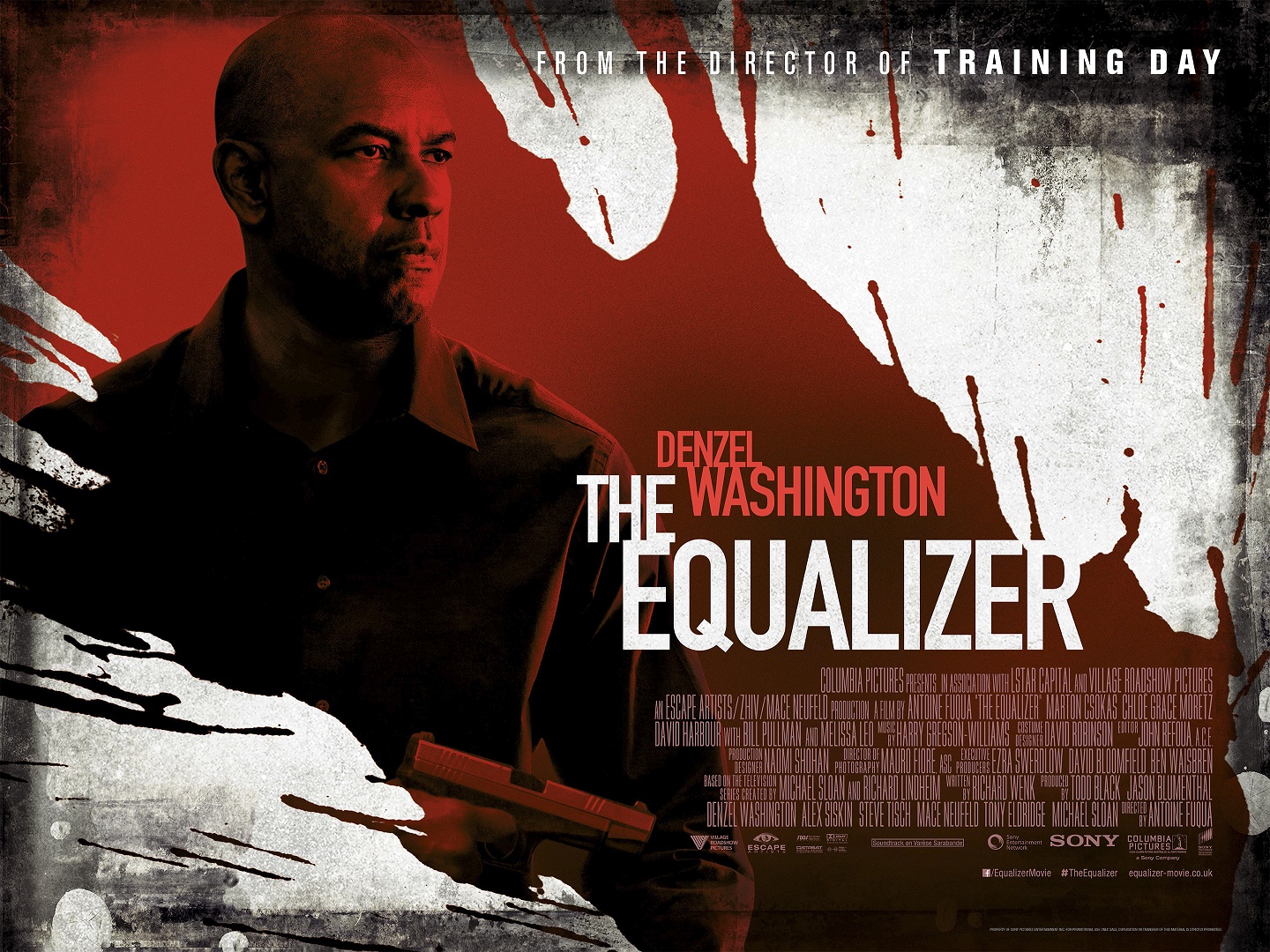
I consider "from the director of OLYMPUS HAS FALLEN" to be a far more encouraging tagline
Denzel Washington has sadly lost his touch. Not as an actor, mind you, he's still pretty great there. However, he either is having a serious midlife crisis or has a terrible agent, because he's pigeonholed himself into doing one crappy action movie after another (many of them directed by the late Tony Scott), with the last really great movie under his belt being the eight-year-old INSIDE MAN (FLIGHT was decent but uneven). The latest in this line of generic extravaganzas is THE EQUALIZER. It was directed by Antoine Fuqua, aka the director of OLYMPUS HAS FALLEN (aka the greatest movie to watch while drunk), but also TRAINING DAY for those remembering his last collaboration with Denzel. Sadly, since then he's become sort of like a proto-Tony Scott, belting out one action movie after another, only without any of the borderline experimental and hyperkinetic style that makes Scott's movies interesting. THE EQUALIZER is a glum, plodding, and most damningly, boring action movie that offers virtually no surprises or thrills. Denzel gets pretty far on charm alone, but it's not enough to save this rickety ship. 3/10 GONE GIRL
Only Fincher could make this image that interesting
Thankfully, I saw David Fincher's newest outing next, and that made for a far more engaging filmgoing experience. GONE GIRL is delightfully dark, trashy, and sociopathic, with Fincher providing a flawless translation of Gillian Flynn's (who also provided the excellent screenplay) novel about a journey into a marriage's heart of darkness. It's got all of Fincher's usual pleasures as well, with the low-key and unnerving score by Trent Reznor and Atticus Ross, Jeff Cronenweth's dark and moody cinematography, and of course, Fincher's masterful direction. He also absolutely nails the casting, with Ben Affleck delivering the performance of his career. He was born to play Nick Dunne, and he's just as perfect as one would imagine while reading the novel. Rosamund Pike, though, is on another level as Nick's wife Amy, the titular gone girl, as we watch these two extremely detestable human beings navigate the icy waters of marriage. It isn't Fincher's best movie, but it's probably his best one that isn't a masterpiece. 8.5/10 JOHN WICK
The man who kills the boogeyman...
Now THIS is an action movie. JOHN WICK is everything that THE EQUALIZER should have been, and so much more. After years of providing action movies with all the stunts, David Leitch and Chad Stahelski step behind the camera, and deliver what will become a modern action classic. Not only is JOHN WICK filled with kinetic action, vibrant cinematography, and a healthy dose of humor, but it also succeeds at building a fictional world parallel to ours, one run by assassins. It's more ambitious and exciting than the places that most action films would go, and it enriches the already invigorating experience. As a side effect, this movie also gives us a great gift: the return of Keanu Reeves. Reeves plays Wick with the conviction of a man who will destroy the men who destroyed his hope, come hell or high water. It's Keanu's best role in years, and it will hopefully spawn a franchise that will allow us to play in this world for years to come. It also doesn't hurt that it has a stellar supporting cast, including Michael Nyqvist as the almost comically resigned villain, Alfie Allen (THEON GREYJOY) as his shithead of a son, and minor turns from such greats as Willem Dafoe, Ian McShane, John Leguizamo, and even lesser known talents like Adrianne Palicki and Lance Reddick. Make this the action movie you see this year. 8.5/10 NIGHTCRAWLER
LA always looks so badass in movies...
And now, the golden goose of the Roundup, NIGHTCRAWLER. The directorial debut from screenwriter Dan Gilroy (brother of Tony, the BOURNE series writer) feels a lot like a masterpiece. Alternately tense, hilarious, biting, and horrifying, NIGHTCRAWLER is a dark look into the seedy underbelly of Los Angeles crime journalism, as one extremely sociopathic go-getter, Louis Bloom, attempts to fashion himself a career by getting news outlets the footage that more decent men will not. It also gives us possibly the best performance of Jake Gyllenhaal's career, one that he's been working towards for years. Louis is a man driven by nothing but cold hard ambition, and Gyllenhaal successfully sells the ice running through his veins. There are decent supporting turns from Rene Russo, Bill Paxton, and Riz Ahmed, but NIGHTCRAWLER is predominately a one-man show, and Gyllenhaal takes it down into the murkiest, darkest depths. 9.5/10
And that's it for the roundup. I've seen INTERSTELLAR, but I need a little more time to process it. My review will be up soon.
Before the release of THE DARK KNIGHT RISES, I did a ranking of the films of Christopher Nolan, who is still, in my esteem, probably the most interesting mainstream filmmaker working today, at least on a blockbuster level. And with his new film INTERSTELLAR right around the corner, I've decided to do a re-ranking, as my overall opinions on his films have changed over the last couple of years. And while I'm not quite as in love with his work as my younger self, I still greatly anticipate every new film he brings. Onward:
(Note: I'm not going to go into as much detail this time. Mostly just to explain why something moved up/down the list. Also, I still haven't seen FOLLOWING. I'll get to it eventually)
7. INSOMNIA
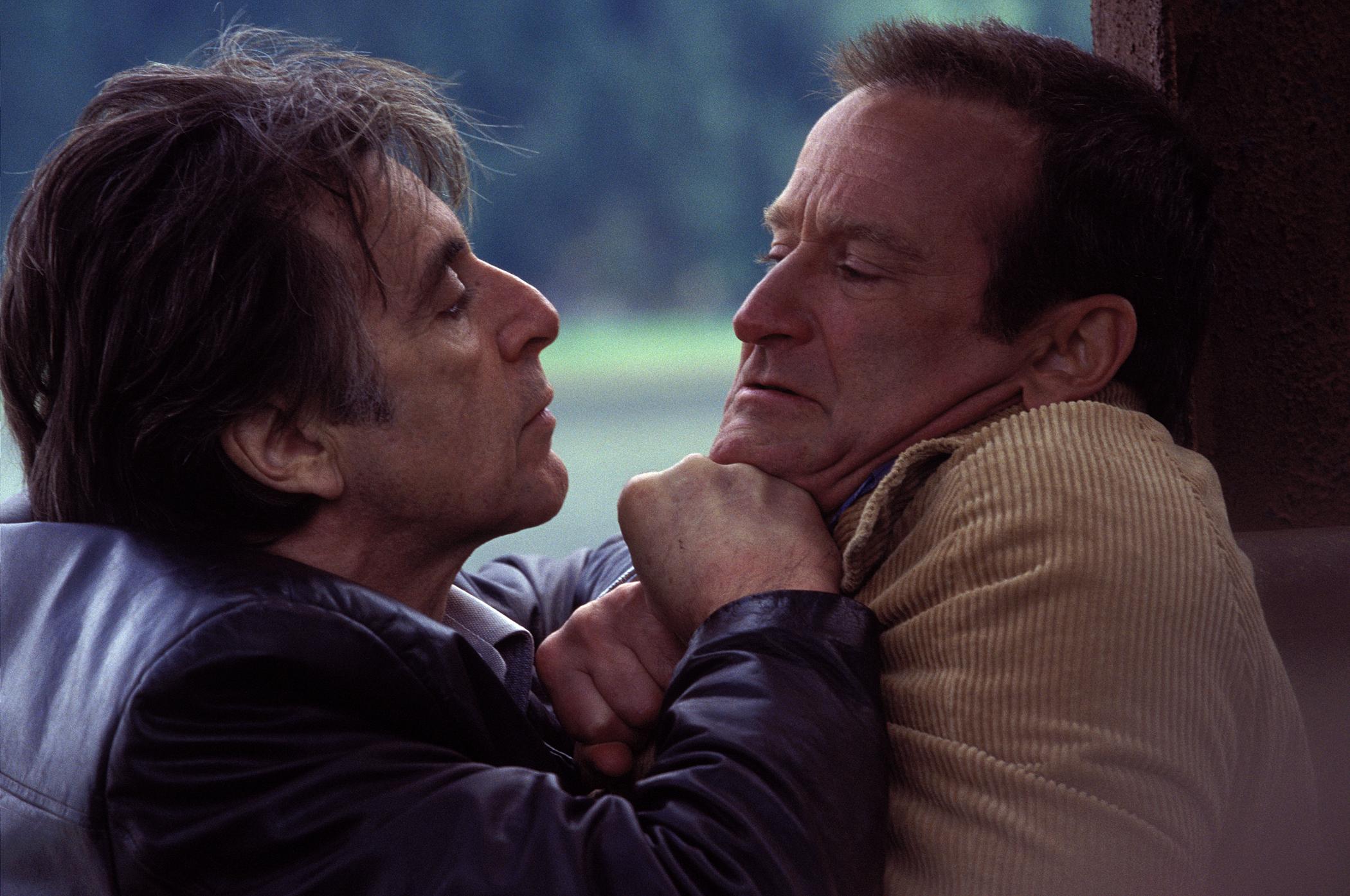
I just remembered Robin Williams was in this. RIP.
INSOMNIA, Nolan's 2002 remake of a Swedish thriller I did not see, remains at the bottom. I've only seen it once, and have no particular interest in revisiting it. It's not even a bad movie, really, but it's easily the most anonymous of his films. Anybody with a competent directorial eye could have made this. It gets a few decent ideas across, but other than seeing the late Robin Williams in full creep mode and the usual loud late-period Pacino performance, there isn't much here you couldn't also get somewhere else.
6. BATMAN BEGINS
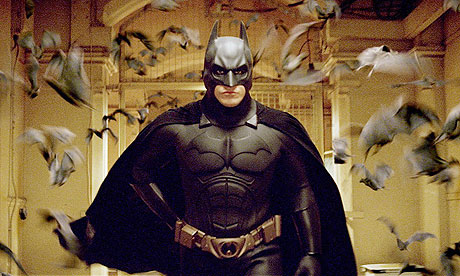
Batman is pissed at his lower ranking
Yep, Nolan's first Batman film has dropped down one. I did a rewatch of his whole Dark Knight trilogy recently, and found up that of the three, BATMAN BEGINS holds up the least. That isn't to say that it doesn't remain a solid superhero movie, because it is. It's just that I don't think it has much of the wow factor its two sequels provide, and its third act has been rightfully vilified as a mess. It's also lacking in the more complex themes at play in the later two installments (we'll get to how clear those themes are in each of those movies in a minute). Also, Katie Holmes. Nevertheless, Bale is my favorite live-action Batman (screw the haters on his Batvoice), Liam Neeson makes a compelling mentor-turned-villain (even if his villainy becomes a bit too obvious by the end), and it has a supporting cast for the ages. Still a definite recommendation, and its two sequels go a long way towards correcting its mistakes.
5. MEMENTO
As many images as I can recycle as possible
That's right, MEMENTO has dropped down several notches. A few years ago, I would've put it as being damn near Nolan's second best film. And now I think it's in the bottom half. Why? Because when you tear away all of its layers and narrative tricks, the story being told just isn't all that compelling, and multiple viewings only weaken the experience. As Roger Ebert himself put it, "Greater understanding helped on the plot level, but didn't enrich the viewing experience. Confusion is the state we are intended to be in". That said, Guy Pearce gives a career-best performance, Joe Pantoliano makes for a slimy frenemy, Carrie-Anne Moss is an adept femme fatale, and the narrative conceit is, at least at first, very cool. Also, the ending goes a long way to redeeming the movie's overall flaws.
4. THE DARK KNIGHT RISES
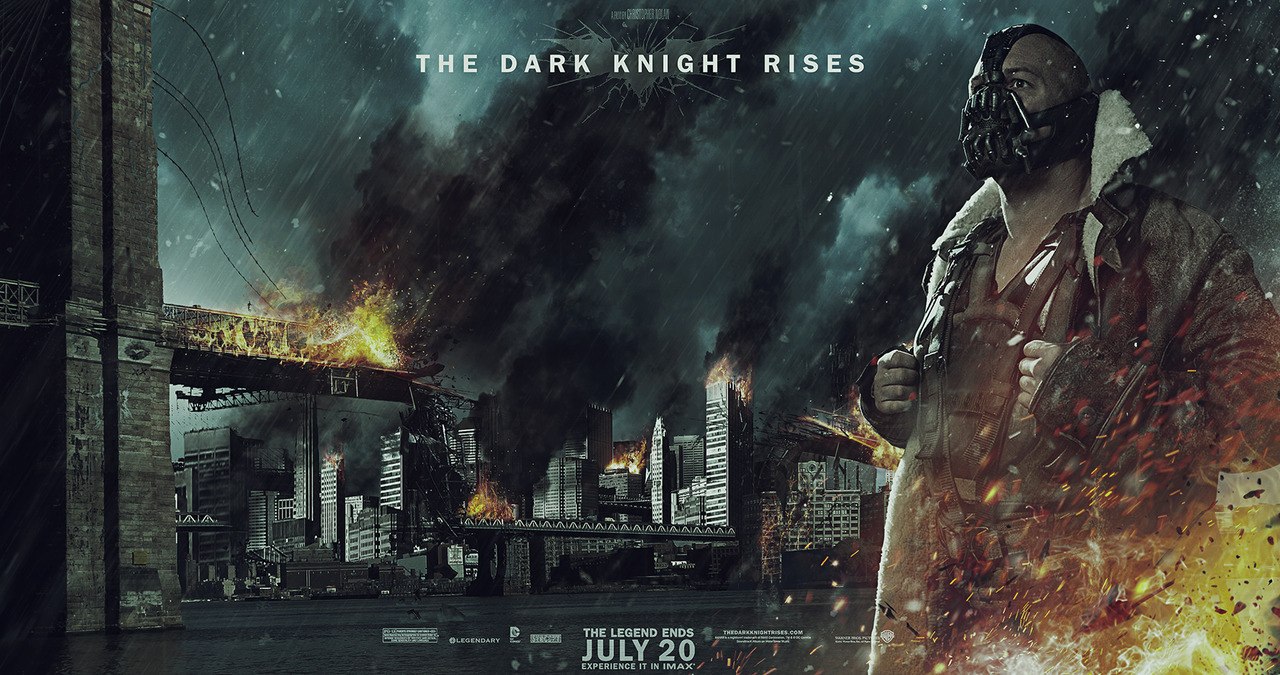
Seriously, all the image recycling I can get...
I'll be the first to admit that my immediate post-viewing review of Nolan's trilogy closer is a tad hyperbolic. I gave it a 9.75 at the time, and now I'd say I'd be more comfortable with somewhere between an 8.5 and a 9. THE DARK KNIGHT RISES lacks the near-perfection and thematic cohesion of its immediate predecessor, being 165 minutes of crazy ideas and plot turns and long-term story capping that has to really squeeze to fit everything that it wants to in. Nevertheless, it's one hell of a movie, far more entertaining and spirited than the "grim-n-gritty" naysayers would have you believe. Nolan goes further into heightened reality in the second and third acts of the movie than I anticipated he would, and gives us a pretty badass villain in the form of Tom Hardy's hulking, Sean Connery-sounding Bane (Seriously, that voice is the best of all possible voices). And while it certainly brings Bale's Bruce Wayne to a different conclusion than I imagined for him (and certainly not one that would work with almost any other incarnation of Batman), it nevertheless successfully completes the journey Nolan set out on in 2005. It also has a FLYING TANK, people, come on. I get why people don't like this movie, but the scorn it's had heaped on it since its release is a tad overboard.
3. THE PRESTIGE
Yes, listen to the totally sane Ziggy Stardust and Gollum...
THE PRESTIGE has moved up several slots in my rankings, and for damn good reason. As opposed to MEMENTO, a movie which I feel diminishes in impact on repeat viewings, this one is only enriched by them. The plot twists which initially felt contrived and overly convoluted in my initial viewing suddenly gained new light with more time to contemplate them, and the ending suddenly felt considerably less unbelievable. The movie has a stacked cast (it's Wolverine vs. Batman as rival magicians, for God's sake), it's a wonderful period piece, and the best part is that the whole movie is in that majestic opening shot. You just have to know what you're looking for.
2. INCEPTION
Something something train, something something far away.
Here's where this new ranking starts to get predictable. INCEPTION was tied for the #2 spot 2 years ago, and now it claims sole possession. It's a movie that somehow manages to be both a gigantic blockbuster and an intensely personal work at the same time (something I'm hoping Nolan will be able to recreate in his new film), that touches on how love that is lost can lead to unhealthy longing, while exploring what exactly may go on inside someone's brain, while delivering loads of quick, on-the-fly exposition, while also being a twisty and surprising heist movie. It's a movie with as many layers as the dream that in spends most of its runtime within, and I'm still wrangling over whether it's a masterpiece or not. Either way, it's pretty damn close.
1. THE DARK KNIGHT (Yep, still #1)
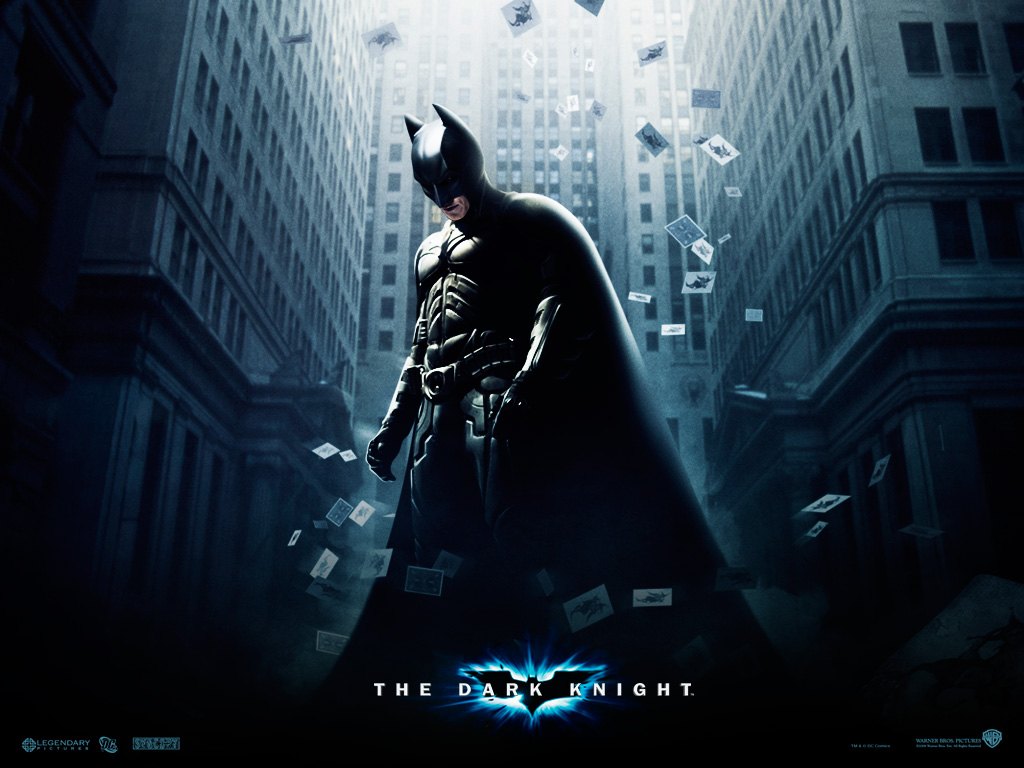
Is Batman not pleased?
This is still one of my all-time favorites. The best superhero movie by a mile (even the cream of the second tier, stuff like THE AVENGERS and SPIDER-MAN 2, sit at least one rung below), THE DARK KNIGHT manages to be a bang-up superhero blockbuster, a sprawling Michael Mann-esque crime saga, a sobering meditation on the occasional necessity of lying for the greater good, a current-events film that zeroes in on terrorism and the changing morality of an ever-graying world, a showcase for one of comics' and cinema's greatest villains (brought to life in a stunning Oscar performance by a sorely missed actor), and one of the best takes on Batman of all time. The ending still gives me goosebumps today.
And there you have it. Opinions change. Maybe I'll get around to ranking another current director's works one of these days (maybe Fincher or Tarantino?). In the meantime, I eagerly await the arrival of INTERSTELLAR on November 7.
Nolan's promising a lot with that tagline. Here's hoping he delivers.
Ten films into their cinematic universe, Marvel has built quite an impressive house for itself, where they feel daring enough to release something as daring, as unique, and as charmingly offbeat as this week's GUARDIANS OF THE GALAXY, directed by no less than James freaking Gunn, the cinematic master of manchildren. GUARDIANS may not be the best movie in this universe (it probably falls somewhere just above the middle of the ten movies), but it may be the one that is most its own thing, apart from the rest, give or take a Thanos. It's not even a superhero film, not really. Feels a bit more like this universe's answer to STAR WARS.
For this review, I feel the good/bad/meh approach might work better than a straightforward series of paragraphs, as it'll allow be to quickly dissect all the things I like and dislike.
Original concept art. There's a disturbing lack of Chris Pratt or Diesel-y Groot.
SPOILERS FROM HERE ON OUT THE BAD
- Ronan
This guy
Now, our villain here may not be a completely outright bad element. There are certainly things that I do like about him. His design, for one. It's one of the most overtly comic-booky designs ever for a character. I can't even tell that that's Lee Pace (of LINCOLN and the HOBBIT movies) underneath, and that in itself is an achievement. Pace also certainly injects as much menace as he can into the guy, and he has a few individual moments towards the end that work, especially his hilarious face when Quill attempts to distract him form destroying the Xandarians with an impromptu dance contest. However, other than these elements, there's just not much to his character. He's cool-looking, but that's about it. There's not much to differentiate him and his motivations from other Marvel villains (he almost feels interchangeable with Christopher Eccleston's Malekith from THOR: THE DARK WORLD), and a movie as big and crazy as this one could've used a crazier villain. He wasn't completely terrible, but I feel we deserved more.
- Pacing
It takes a while for GUARDIANS to jump into high gear. It opens with a sad and wonderful (almost Pixar-esque) scene where a young Peter Quill has to deal with the death of his mother on 1988 Earth, only to be hastily abducted by Yondu's crew of Ravagers for space places unknown. It then gives us a cool sequence where we see the older Quill go about his goofy theft of the McGuffin Orb. Once the movie goes outside Quill's orbit, however, things get a bit trickier. We are immediately thrown into this conflict between the Xandarians and the Kree, and we must immediately jump aboard Ronan's ship and learn about his dealings with Thanos and his daughters very rapidly. The movie moves at a fast clip all the way through the rest of the first act, before reaching a bit of a lull during the second, before kicking into high gear again for the final battle. The final 45 minutes of the movie are perfect and outstanding, giving us all the cosmic Marvel weirdness we ever could've asked for, it just takes an uneven 75 to get there. There's plenty of great scenes in the first two acts (the street chase between Gamora, Rocket, Groot, and Quill, the prison sequence), but it doesn't coalesce as well as the end of the movie does. GUARDIANS has a whole new universe to establish, essentially, in a fraction of the runtime that the rest of the Marvel universe has had, and it struggles initially to bring everything together. Once everything clicks together over halfway through the movie, however, it works like gangbusters.
- Score
Now, Tyler Bates' score is nearly as bad as Henry Jackman's incomprehensible gurgling from CAPTAIN AMERICA: THE WINTER SOLDIER (the only real glaring weakpoint of that movie). But nor does it ascend to the heights of Brian Tyler or Alan Silvestri's Marvel scores. It has a definable, soaring theme, yes, but not much else. Most of the action music sounds much like stuff we've all heard before.
- Occasional CGI Overload
This may have been inevitable in a space adventure movie, but there are a few moments in GUARDIANS where the CGI can begin to overload your brain. It never reaches the cartoon world of the HOBBIT movies, but certain characters (*cough cough THANOS*) would have benefitted from a bit more of a grounding in reality, and the space battles could've used a bit less minutiae (there are bits at the end that reminded me unpleasantly of the opening of REVENGE OF THE SITH, only slightly less intrusive).
Thankfully, that's it for the bad. On to the meh!
THE MEH
- Gamora
*Not in the movie
In a cast decorated with multiple rich, colorful, and hilarious characters, Gamora is at best a mixed bag. She is given clear motivation and purpose and kicks loads of ass, but she lacks much personality. Zoe Saldana (first a human space lieutenant, then blue cat tribal girl, now green murderer) does her damnedest to bring out the most she can from the character, but other than a few moments of perfection ("I will not succumb to your pelvic sorcery!" being a highlight not just of her character, but the movie) Gamora never quite gets there. Plenty of room to explore her in the sequel, I guess.
- Nebula
"I might be key to the universe one day, but for now I'm just here!"
Nebula suffers from many of the same problems as her sister. Karen Gillan does succeed as imbuing her with menace, just as Pace did with Ronan, and like Gamora, she kicks the crap out of a lot of dudes. But other than giving Gamora someone to fight at the end, she lacks much actual purpose in the movie but to be "the henchwench". Her and Gamora could have had an interesting and complicated relationship about their opposition to each other, and how it relates to their "father" (who I'll be getting to in a minute), but instead, they just try to kill each other at the end. It's ultimately a missed opportunity, especially considering if Marvel chooses to do a straight "Infinity Gauntlet" adaptation for AVENGERS 3, where Nebula would presumably play a key role.
- Thanos
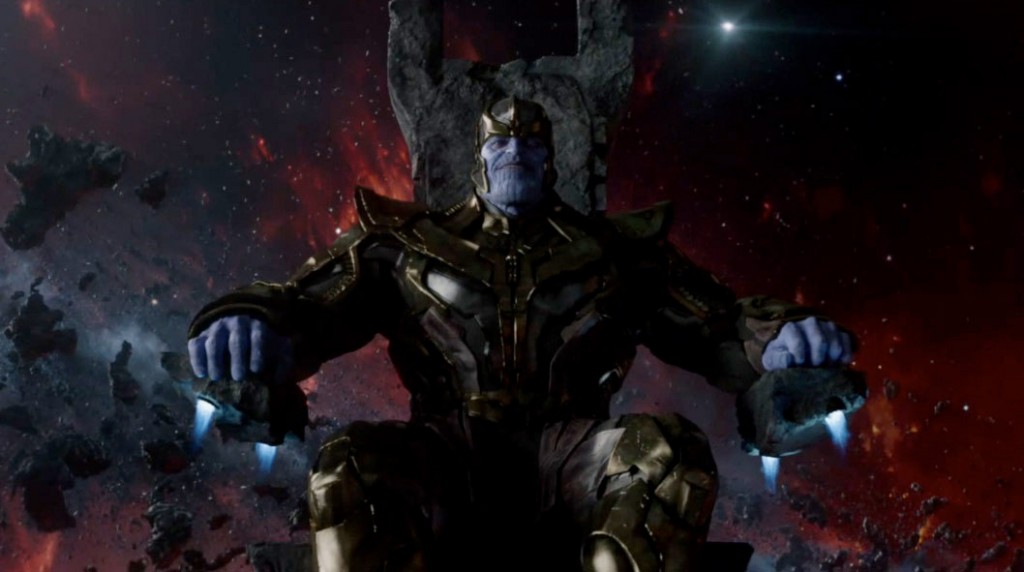
I AM THE PORTENT OF DOOM, here to kick ass, chew gum, and fuck Death.
After yet another brief appearance in a Marvel movie, I'm wondering when we're going to be getting more of this guy. They might be saving him up entirely for AVENGERS 3, but it'd be nice to know a thing or two about him before that. Right now, all we know is that he hangs out on the same throne all the time, and that he speaks with Josh Brolin's voice. I like the full design's accuracy, and the fact that he looks a little like Brolin. Brolin's voice is perfect, too, all menacing and such. It's not that Thanos is a problem in and of himself, it's that his role in the movie's a bit superfluous other than a fan wank for the future. I want more, dammit.
- The Collector
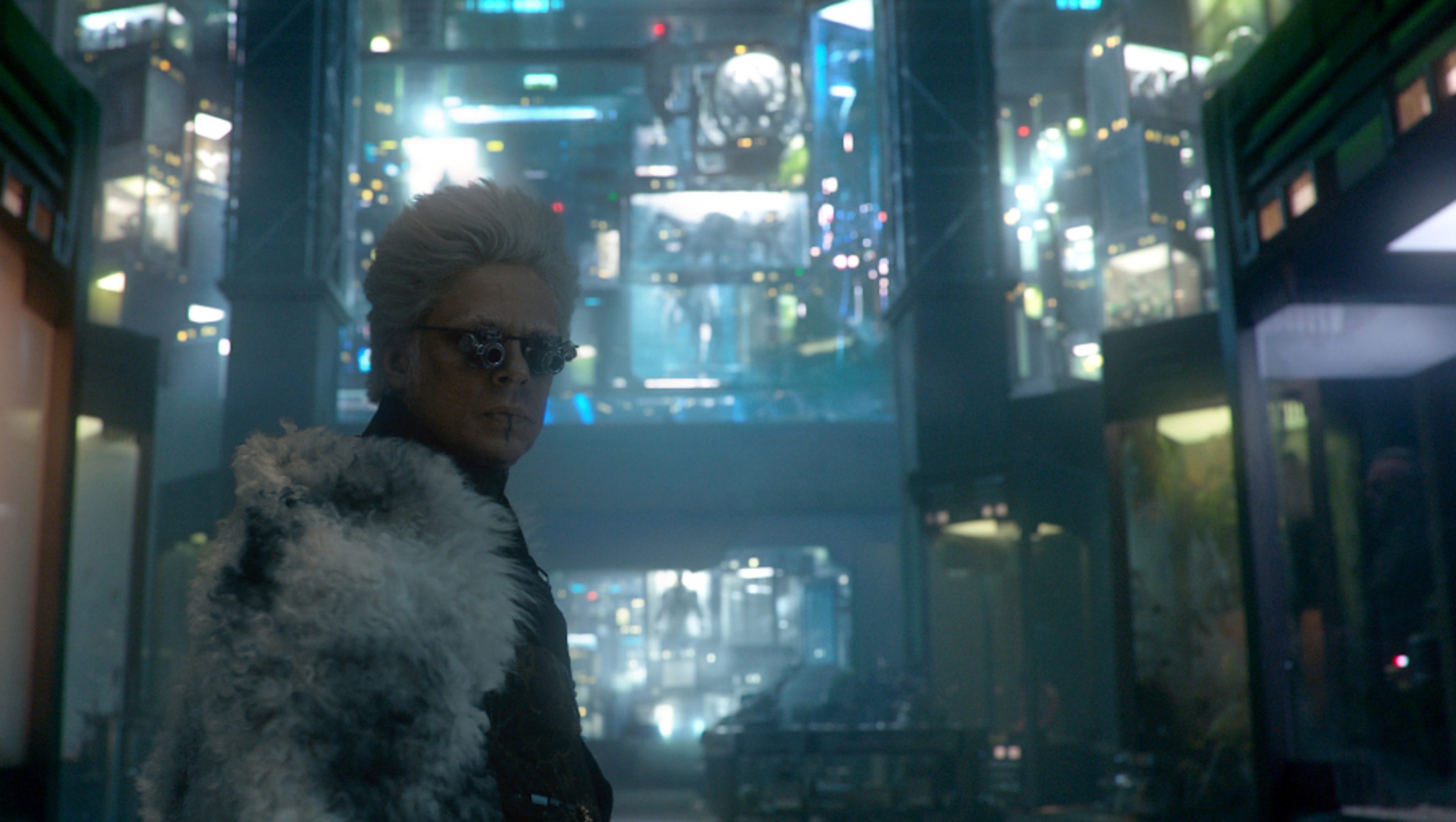
This fucking guy
Another example where the character feels like little more than a wank. I'm enjoying Benicio del Toro's gonzo performance, and the character feels about as morally questionable as they get (he seems innocent enough at first, but then we find out that he's basically keeping slaves, and he comes off like that guy who attempted to "collect" Data in that one TNG episode), which makes him interesting. But other than his Infinity Stone explanation (four so far in the MCU, I believe?), he serves almost no real purpose in the movie. I DO like that his name is Taneleer Tivan, though. Got to keep that Stan Lee naming convention up.
Guess, that's about it for the "meh", then. Now on to the good (REALLY GOOD) stuff.
THE GOOD/FUCKING AWESOME
- Drax
The best picture that I could find.
Based on the promos for the movie, as well as the casting of former WWE guy Dave Bautista, I expected Drax to be little more than the group heavy. HOLY SHIT was I wrong. Shockingly, Drax almost ends up stealing the whole damn movie, with his inability to understand subtlety or metaphor played up to maximum comedic effect. Bautista is perfect, too. His little glances are fantastic, as is his ever-deadpan line delivery. He takes this literal brute of a guy and manages to make him feel almost soulful. ("Quill, you are my friend. This dumb tree stump, he is my friend. This green whore, she is-". "Nothing goes over my head. My reflexes are too fast, I would catch it".)
- Rocket
The most real hysterical laugh of his entire life.
Unlike Drax, Rocket had sky-high expectations, and he met them. This little raccoon has the most personality by far out of anyone in the movie, and Bradley Cooper modulates his voice so well that you can't even tell it's him. Watching a two-leg-walking talking raccoon get drunk and threaten a green Dave Bautista with a gun is one the best things ever, as is his penchant for getting people to remove prosthetic body parts for LOLZ. Rocket and Groot's relationship is the soul of the movie, as well, with no other pairing feeling as deep or heartfelt. When Rocket screams "YOU KILLED GROOT" at Ronan, it takes a scene that could have been goofy and makes it almost genuinely heartbreaking.
- Groot
"We are Groot". *Entire audience bursts into tears*
Say hello to the heart of the movie. Like his Iron Giant, Vin Diesel takes a character with not a ton to say, and gives him a real soul. Gunn gets a ridiculous amount of mileage out of making comedic situations from "I am Groot", the character's weird abilities never cease to amaze or amuse, and his smiles could melt any cold hearted bastard. Also, little Groot dancing at the end is AMAZING.
- Star-Lord
"STAR-LORD!!!!". "Finally..."
None of this movie would've worked without Peter Quill, and Peter Quill wouldn't have worked without Chris Pratt. Pratt gets his career-making role here, with all the bravado of Han Solo and the goofy, lunkheaded charm we've come to expect from him on PARKS AND RECREATION. Though the movie has five main characters, Quill is the key that makes the rest of them work, and Pratt knows how to handle him. Quill comes off as bold and brave, but also as kind of an idiot who needs to be kept in check. All of the Guardians complement each other. Apart, they were a bunch of misfits. Together, as Ronan said it bitch, "they're the Guardians of the Galaxy". And Star-Lord is the lynchpin.
- James Gunn
There was no other writer/director as suited to this material as Gunn, and here, he fully makes the Marvel Cinematic Universe his own. Like Gunn's other movies, the main character is a misfit manchild who can't move beyond a critical event in his past (Rainn Wilson couldn't deal with his wife leaving him in SUPER, just as Quill can't accept his mother's death), and Gunn executes that material just as beautifully here. From the quirky humor, to the gonzo wonderful soundtrack, it's the most auteur expression in the Marvel universe since Shane Black's IRON MAN THREE.
- Soundtrack
Where Bates' score fails, the soundtrack succeeds beyond wildest dreams. From the "Hooked on a Feeling" introduced in the first trailer, to the rocking "Cherry Bomb", to wonderfully cathartic appearance of "Ain't No Mountain High Enough" at the end (second successful deployment of Marvin Gaye in a Marvel movie in a row, BTW), it's just fantastic, and unlike some other superhero soundtracks (*cough cough PRINCE BATMAN*), the songs are successfully deployed in the movie.
- Third Act
The third act of this movie reinforces how far Marvel's come in its willingness to go all out in a movie's climax. Nine movies ago, a robot-suited Jeff Bridges was throwing cars at Tony Stark on an LA freeway. Four movies ago, Tony Stark threw a nuke at some aliens. And now, loads of alien ships are firing at each other on an alien planet while our heroes infiltrate the enemy spacecraft and Rocket is flying around like a bat outta hell. The scale has most decidedly been upped. Presumably, next year's AVENGERS: AGE OF ULTRON will up it again.
- Howard the Duck
Unrelated to the George Lucas abomination
FUCK. YES.
GUARDIANS OF THE GALAXY gets an 8.5 out of 10.
Phase Two is almost over. AVENGERS: AGE OF ULTRON opens May 1.
After the disastrous TRANSFORMERS: AGE OF EXTINCTION threatened to derail this otherwise stellar summer (setting aside the lousy opener that was THE AMAZING SPIDER-MAN 2), in comes DAWN OF THE PLANET OF THE APES, putting things back on track by giving us not only arguably the best film of the summer, but one of the best of the year.
And I say this as a general non-fan of the PLANET OF THE APES franchise.
Yes, as I stated before in my review of RISE OF THE PLANET OF THE APES (which feels like I wrote it a lifetime ago), I have never been particularly enamored with the concept of this series. I found the original film dated and sort of lacking, with cheesy antiquated ape makeup and a extremely slow-burn pace, and can barely remember the sequels (though it says something that DAWN makes me want to revisit them. Maybe I can view the originals with fresh eyes now). Tim Burton's remake is the most hollow garbage imaginable; it's the movie you fear one would make handed the keys to this kingdom, with ridiculous humor (see: monkey sex/foreplay, apes going apeshit for no reason), B-movie level acting (not AGE OF EXTINCTION star Marky Mark's finest hour by any stretch of the imagination), and an infuriating and ludicrous ending that simply makes you wish you could get those two hours of your life back. After it served as the BATMAN & ROBIN of the series, director Rupert Wyatt was brought in for RISE, in order to adopt a more basic, modern approach in the vein of BATMAN BEGINS. I rewatched RISE as prep for DAWN, and I mostly stand by my original review on that one, as a solid, entertaining piece of work with one truly remarkable bit of performance and effects work colliding in Andy Serkis as Caesar, but a mostly empty and one-dimensional human side. It bugs me that the movie is almost completely pro-ape, while the humans either range from misguided (James Franco, who needs to stick to the stoner comedies with Seth Rogen and Danny McBride. It's where he truly belongs) to completely mercenary and self-absorbed (the laughably greedy business exec played by David Oyelowo) to simply dickish and deserving of death by plague flu (Draco Malfoy's cruel ape prison guard). It works in general, but other than Caesar, it all feels a little slight. Wyatt does OK work on his first big movie, and Weta's ape effects are basically still perfect and seamless today, but RISE really needed a little more meat on the bones. It aimed to legitimizing the concept as a sophisticated, fully serious piece of science fiction, and at times it comes pretty damn close, but its lack of dimensions results in it never really quite getting there. It deserves a 7.
I was interested in where a potential sequel would go, but I wasn't exactly anticipating another one. Wyatt leaving didn't particularly surprise me, as Fox has had trouble locking down directors for their tentpoles since the dawn of time (note that Matthew Vaughn ditched X-MEN: DAYS OF FUTURE PAST the very same week). Having never seen CLOVERFIELD or LET ME IN (though I have seen LET THE RIGHT ONE IN, the masterful original Swedish version), I was pretty unfamiliar with the body of work of new director Matt Reeves, though the decision seemed to make most fans fairly happy. I also thought completely recasting the humans was the right call, as none of them made a particular connection the first time out, and filling the new cast with stellar performers like Gary Oldman and Jason Clarke certainly didn't hurt. What really piqued my interest was the new post-apocalyptic landscape, a far more interesting setting than the overly docile and peaceful San Franciscan suburbia of the first movie. The trailers ended up being enough to sell me, so I settled in to give DAWN OF THE PLANET OF THE APES a shot.
And I am very glad that I did.
DAWN OF THE PLANET OF THE APES, if RISE was the BATMAN BEGINS of these films, is THE DARK KNIGHT. It's THE EMPIRE STRIKES BACK to the original STAR WARS. It is THE ROAD WARRIOR to MAD MAX. It's that rare sequel that builds on, improves, and transcends everything about the original. It's thoughtful, tense, action-packed, morally and thematically complex, filled to the gills with character, and put simply, fucking awesome. It legitimizes the APES concept in every way, and delivers on the wpromise that the first movie in this rebooted series had hiding in its best moments.
And it may make a PLANET OF THE APES fan out of me yet.
(SPOILERS FROM HERE ON OUT)
Reeves, after making two mid-budget movies, one a found footage monster mash and one a remake of a classic foreign horror flick, erupts onto the summer scene here, with a movie that is sweeping, confident, and filled to the gills with dread. We see an Earth that holds the remains that humanity has left in its wake as a result of the James Franco-developed flu virus, a world where everyone would be uplifted just by lights, warmth, and a good song blasting on the CD player. But we see the apes first, and how far they've come in the decade since RISE, building an almost alien tree village as they solidify their numbers in the redwoods across the Bay from San Francisco. The movie opens with a stunning 15-20 minute sequence with no dialogue as the apes collect food for their group. Caesar (Andy Serkis, owning the role once again, this time bringing gravitas and wise leadership on top of his preexisting humane qualities) has managed to establish a familial community with his evolved ape brethren, one dictated by the simple doctrine "APE NOT KILL APE". However, there is dissension in the ranks, as when human survivors are revealed in the apes' territory, blood is shed born from fear, and the human hating Koba (the scarred lab test subject from RISE, now mocapped by Toby Kebbell, who gives Serkis a run for his money with his dark, haunted, and sadistic performance) seizes the opportunity by attempting to press Caesar to engage the humans in battle. Caesar instead attempts to broker a fragile peace with the assistance of the reasonable and sympathetic human Malcolm (Clarke, in an understated role suited to his more everyman qualities (see ZERO DARK THIRTY and his downright affable torturer), as opposed to the melodramatic, over-the-top ham he displayed in like THE GREAT GATSBY and WHITE HOUSE DOWN), who seeks to reach the dam beyond ape territory to attempt to bring the power in San Fran back to life, and in turn, to attempt to begin to find others and properly commence to rebuilding of the human race. However, apes like Koba and men like Dreyfus (Oldman, not as villainous as the trailers made him out to be. Here his actions are downright justifiable) and Carver (Kirk Acevedo, basically playing a tamer version of his WALKING DEAD character), push the sides closer to war, as the situation becomes increasingly complicated.
And that last sentence gets at the heart of where DAWN succeeds where RISE could not. In DAWN, both peoples' standpoints are thoroughly addressed through multiple perspectives. Caesar and Malcolm represent the ones who simply want to protect their families and people from further bloodshed, while Koba's past history of experimentation only seeks to drive him to try to force humans to see things from his angle, eventually becoming so tyrannical as to demand that an ape must kill innocent humans, and killing him when he fails to do so. Men like Dreyfus and Carver are equally at fault, as they live in a cycle of paranoia that drives Carver to bring a shotgun into a situation where the apes demanded the guns be left at home, and causes Dreyfus to decide to bomb their base tower in order to attempt to wipe out all the apes in one shot. Eventually, Koba's bloodthirstiness forces Caesar to make the ultimate choice, to break the ape code he created to stop it from crumbling permanently. Unlike Michael Bay's recent atrocity, Reeves actually considers the implication of what Caesar letting Koba die truly means. He violates ape code by utilizing simple semantics, and if history is any indication, this small crack in the code could one day open into a full-on chasm. And then Caesar must make the next difficult decision (which is spoiled in the trailers, no less) to lead his people into war as a reluctant commander. Malcolm says "I thought we really had a chance", and Caesar agrees. Because of actions born from fear and hatred, the world the apes could have salvaged will continue to fall to ruin, perhaps one day leading to a world where a certain astronaut will collapse on a beach in despair as he stares at the remains of the planet he once knew...
Or perhaps Reeves will take us in a completely new direction (he's already signed on to return for the third film).
Either way, I can't wait.
And that's something I did not think I would be saying about a PLANET OF THE APES movie.
Kudos.
DAWN OF THE PLANET OF THE APES gets a 9.5 out of 10.
I'll be back for GUARDIANS OF THE GALAXY.
Nitpick: shouldn't Koba be the one on the horse? Also, that bridge never explodes.
Also, my rankings of the summer movies I've seen:
1. DAWN OF THE PLANET OF THE APES
2. EDGE OF TOMORROW
3. 22 JUMP STREET
4. X-MEN: DAYS OF FUTURE PAST
5. GODZILLA
6. The GUARDIANS OF THE GALAXY trailer
77. The guy yapping behind me in every movie I've ever been in.
824. My dad constantly making ape puns in DAWN, mostly revolving around bananas.
1056. THE AMAZING SPIDER-MAN 2
22,593. Koba's vision of the future where humans would live in cages.
429,384. Crack addiction
1,394,959. Me dying by torture a la the death scene from BRAVEHEART (at least "freedom" would mean something there).
1,000,000,000,000,000,000,000,000,000,000,007. TRANSFORMERS: AGE OF EXTINCTION
Hint: This is not nearly as awesome as this image would suggest.
So, I gotta say, Summer 2014 has been, for the most part, an excellent year for the tentpole movies. Before the summer even began, in the spring we got NOAH, a complex and unique biblical epic from Darren Aronofsky that gave us the resurrection of Russell Crowe (which also happens to be my favorite movie of the year so far), and CAPTAIN AMERICA: THE WINTER SOLDIER, a political thriller disguised as a superhero movie that really gives THE AVENGERS a run for its money. After that, there was a stumble with THE AMAZING SPIDER-MAN 2, quite possibly the worst Spider-Man movie yet; a mess that was more concerned with setting up the franchise than being a satisfying standalone film. However, after that, it's been smooth sailing since. From the slow build to kaiju wrestling Nirvana that was Gareth Edwards' artfully made GODZILLA, to the time-traveling franchise reboot/capper combo that was X-MEN: DAYS OF FUTURE PAST (that also served as a resuscitation of director Bryan Singer's career), to the shockingly witty and cathartic experience that Tom Cruise gave us in EDGE OF TOMORROW (shockingly, one of the best blockbusters in years), to the brilliant meta-inversion of the typical comedy sequel of 22 JUMP STREET (in my opinion, an improvement on the first film every way). When we've got filmmakers like Aronofsky, the previously untested but surprisingly crackerjack action direction of the Russo brothers, Edwards, Singer, Doug Liman, and the unstoppable director team of Lord/Miller, it's safe to say that for the most part, this summer has been in excellent hands.
Enter Michael Bay, and with him, TRANSFORMERS: AGE OF EXTINCTION.
As some might have guessed, I am not the biggest fan of Bay, or this particular franchise that he keeps coming back to for reasons known only to himself (read: MONEY). While the first TRANSFORMERS was a fun and enjoyable, if bloated, adventure that didn't take itself too seriously, both Shia LaBeouf-starring sequels that followed ranged from "pretty bad" (DARK OF THE MOON) to "worst movie of the century contender"(REVENGE OF THE FALLEN). A series that found its origins from children's toys and simple cartoons became a wheel spinning, convoluted, hyperviolent (disguised as not-violent because robot carnage instead of people) spectacle of nonstop Bayhem that assaults its viewers with constant sound and fury until their brains are fully scrambled. However, there was hopes (if however slight) that Bay might take things in a new and hopefully better direction this time. His last film, PAIN & GAIN, though flawed, showed an interesting new side of the director that showed that with the right script, he could be far more engaged with his material. Shia was also gone, and replaced with the more capable (if director dependent) Mark Wahlberg, the entire human cast of the previous films was jettisoned, and the number of robots was significantly reduced, possibly making one think that AGE OF EXTINCTION would take a back-to-basics approach that also served to give the fans of the franchise more of what they wanted (Dinobots, robot fighting) and less of what made Bay's last two movies so dire ("comedy", racist robots, psychopathic heroes that brutally kill their enemies and ALLOW AN ENTIRE CITY OF PEOPLE TO DIE to prove a point about "freedom" or something).
Think again.
Despite thinking that this franchise could not get any worse, TRANSFORMERS: AGE OF EXTINCTION is a grueling experience, one that assaults your brain with even more sensory overload than the previous films, a movie that clangs and bangs for 165 minutes (!!!!!!!!!!!) before finally allowing itself to die. It unbelievably approaches REVENGE OF THE FALLEN levels of bad, something that I bet most thought even Bay would never sink to again. Even worse, it amplifies many of the previous films' problems. The Autobots are now full-on sociopaths, "heroes" who constantly discuss how much they enjoy killing, and proceed to do so every chance they get. It has a schizophrenic and completely unlikable Optimus Prime, who does nothing but grouse about how humanity has fucked him over, before vowing to kill a human, something that DIRECTLY CONTRADICTS THE VOW HE MADE ABOUT NOT HARMING HUMANS IN THE FIRST FILM. He convinces the Dinobots (who suck, by the way, and are barely in the movie at all) to help him by lasciviously running his sword over Grimlock's face and saying, immediately after stating his "freedom", "you will defend my family... OR DIE!!!" Bumblebee is suddenly a whiny manchild who bitches on about how he hates the human-made knockoff of him, before brutally murdering him. The other Autobots, including Hound, a John Goodman-voiced fat bot with a beard made of wires (spare me) and a cigar, and Drift, a samurai stereotype robot who addresses Prime as "sensei" (God help us all), simply do nothing but bicker and state their intended desires to get a good kill in before the day is done. The robot villains are even more useless, as Lockdown has motives that are nebulous at best, as he is a bounty hunter working for the "creators" of the Transformers that we never see, but apparently killed the dinosaurs. Galvatron is also useless, as he only is there to give robots for the Autobots to battle in the Hong Kong climax, and makes the human villains look phenomenally stupid for bringing him to life in the first place.
I am... GALVATRON! I also reduce the former franchise villain to merely being a heavy.
The human side of things aren't much better. Wahlberg turns in a bland, goofy performance as the hilariously named Cade Yeager, a Texan who suspiciously sounds like he's from Boston for some reason. He never quite reaches the levels of ham that he ascended to in THE HAPPENING, and he's certainly more convincing in the (still nonsensical) action sequences than LaBeouf ever was, but he's simply not very good. Nicola Peltz (look to THE LAST AIRBENDER for the warning signs) must be one of the worst actresses to ever have a camera pointed at her, as her delivery is eternally stilted, and her role serves no purpose other than to be the damsel in distress, who must be rescued by the creepy love triangle forming between her, her Lucky Charms Irish race car driving boyfriend (who does nothing in the movie, by the way), and her increasingly creepily overprotective dad. Other actors, such as Kelsey Grammer, Titus Welliver, Sophia Myles, and Li Bingbing, barely register at all, with Grammer simply being a generic paranoid government villain and Welliver being a typical Black Ops-style asshole. The only actor who I really have anything positive to say about is Stanley Tucci. Sure, he's just sort of fucking around the entire time in his role as Joshua, the arrogant inventor of the human-made Transformers, but his goofy performance is oddly endearing, and he's about the only anchor the audience can cling to for the entire film, even if he at point suggests running over a crowd of Chinese people.
Bay is still a master of visual effects, as everything here is completely seamless, and the robots do not look fake in one single shot. There are a couple of individual action beats that work as well, such as when the camera rotates around in a dogfight between two spaceships over Chicago. But the robot combat is still completely incomprehensible, and it almost feels resigned, which brings me to my final and most important point about this film:
MICHAEL BAY DOES NOT GIVE TWO SHITS ABOUT THESE MOVIES.
Think about it. He's only in it for the money at this point, if he even ever was invested before this. AGE OF EXTINCTION is an ugly, cynical, mean-spirited product of a movie, one loaded to the gills with product placements that include constant shots of Victoria's Secret and Miller Genuine Draft trucks and even Wahlberg downing an entire bottle of Bud Light in one scene. It's a movie based on toys and a cartoon for kids that has comedian TJ Miller getting fried to the gills by missiles, before lingering for roughly ten seconds on a shot of his charred corpse. It features a cast of Autobots that relish killing, and a leader that uses fear and threats to get what he wants, while proclaiming it all to be in the name of "freedom". In short, TRANSFORMERS about the most cynical blockbuster franchise out there, with AGE OF EXTINCTION serving as its nadir, at least in this regard. I gave him three chances on the basis of enjoying the first film, but now I finally am ready to say:
Fuck this franchise, and fuck Michael Bay.
I'm DONE.
TRANSFORMERS: AGE OF EXTINCTION gets a 1 out of 10.
Do yourself a favor, and go see EDGE OF TOMORROW instead, a smart witty summer movie involving robots and aliens that actually gives a shit about its audience, building to a wholly satisfying ending.
EMBRACE THE CRUISE. You'll be better for it in the end.
If you don't start watching this show, a kind of... countdown will begin
SPOILERS Breaking Bad is my favorite television show of all time.
I know, colossal shock. But it's been my favorite show for several years now, long before it hit the zeitgeist and became everyone's favorite show, culminating in Sunday's finale raking in over 10 million viewers, unheard of ratings for a cable network. As much as I like to have been one of the people onboard before the show arrived on Netflix, that's what really gave Breaking Bad an audience. And as I posted after last year's midseason finale, Vince Gilligan and his team of writers had done so well after 54 episodes. However, many a series falters in its final stretch of episodes, as the writers occasionally struggle to deliver a fully satisfying conclusion. There's a reason why the ending of The Sopranos is so controversial, as is the polarizing ending of Lost. There's always that possibility that even the best team of writers (and with Breaking Bad, you're getting the very best) will overdo it in their attempt to deliver, give an ending fitting to the series but ends up alienating the core audience, or simply drop the ball and not stick the landing (case in point: the Dexter finale of a few weeks ago, or even the final season as a whole, which just plain sucked). So, even with only 8 episodes left, all the way down to Sunday night, that inevitable feeling was there that this might be the moment where Breaking Bad falters after years of success.
Thankfully, this wasn't the case. The last eight episodes of Breaking Bad may constitute the best final season in the history of television, and also reveals the show for what it always really was: a modern Shakespearean tragedy. Though I have some small issues with the very last episode, that Shakespearean structure generally makes up for them.
Give that Shakespeare idea a thought. There are 5 seasons in Breaking Bad, which may well constitute 5 Shakespeare acts. Act I establishes the characters and sets the wheels in motion for the tragedy to come. At the end of the first season, Walt, despite killing several adversaries and rejecting an opportunity to make an early exit from the meth game, is still a relatively sympathetic figure who we've come to know and root for up to that point. He's essentially an inverted Macbeth figure, as instead of a promise of future glory in kinghood, he's given a portent of doom in his inoperable lung cancer, driving him into a dark corner where he feels that the criminal life is the only escape. Act II pushes the story forward, as Walt slips deeper and deeper into darkness and his lies gradually grow larger, while his bad decisions begin to damage the lives of those around him. Jesse is first forced out of his family's lives, and then loses the love he found as a replacement in Jane. As Walt rises to a more prominent position in the meth world, his family life begins to crash to the bottom. Act III is the climax, where as a result of Walt's actions, Skyler becomes embroiled in his criminal life, Hank becomes a victim of his collateral damage, and he and Jesse are forced into a barely inescapable corner, where only yet another evil act can save them (to continue the Macbeth comparison, Gale acts as a sort of Banquo figure). Act IV begins the falling action, where Walt finally makes his true descent into evil by, as Macbeth does, conspiring to kill the king (in this case, Gus), but doing it by manipulating his closest ally. Act V, is the resolution, where all the remaining characters and conflicts come together to conclude the story, features Walt's realization of what he has become, as well as his self-actualization that his motives were far more selfish than he himself had wanted to believe.
However, I find that the Shakespeare comparison applies even more to this final half-season. Consider Act I beginning with Hank emerging from the bathroom, fresh from the revelation that his brother-in-law is the Heisenberg he's been searching for all along and move forward from there. And now, I'm going to get onto the analysis, episode-by-episode, after the jump. Again, FULL SPOILERS for the entire series may lie ahead.
Act I (The Establishment)
"Blood Money"
Me after 5 hours of Badger and Skinny Pete babbling about Star Trek... bitch.
I must say, I was expecting a far slower beginning to this final stretch than what we got. I thought Hank would go deeper into investigating his hunch on Walt over the first few episodes, culminating in Hank truly revealing himself to Walt around the halfway point. This is just how television usually does it, drawing it out and building suspense for the big reveal, so when it finally happens it feels like an earned shock to the system. However, this can also lead to some shows drawing it out unnecessarily for the big twist (case in point, the "twist" from season 6 of Dexter). So, having Hank and Walt's first confrontation occur at the end of the FIRST DAMN EPISODE made it an immensely satisfying beginning of the end. The rest of the episode (as much as I enjoyed Badger's Star Trek monologue) was exactly the pace I expected from the first four episodes, as Jesse's aimless remorse for his actions and Walt's attempts at future anonymity slowly setting things in motion. But when Hank closed the garage door, everything got cranked up to 11. "Tread lightly" may already be one of the most iconic closing lines to an episode of television, and that haunting last shot (this episode was wonderfully directed and acted by Bryan Cranston, by the way) perfectly whets the appetite for the events to come.
"Blood Money" gets a 9 out of 10.
"Buried"
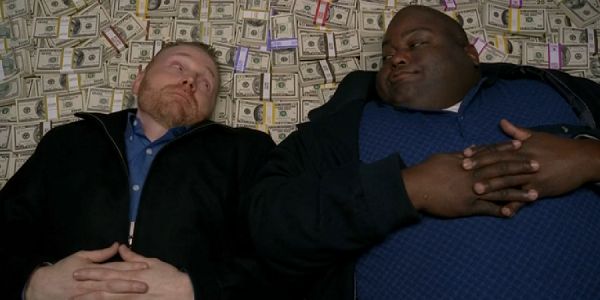
As much as I'm excited for Better Call Saul, I want these guys' spinoff
"Buried" is probably the least of these last 8 installments, but that's more of an observation than an active criticism. It's a table setter, giving hints towards the lines of battle and alliances that will come to fruition in later episodes, while also providing the poetic battleground of the To'hajiilee reservation where Walt and Jesse first cooked in the pilot. It also reintroduces us to Todd, his uncle Jack, and the gang of unscrupulous Neo-Nazis that will ultimately serve as this final season's antagonists. Also, we get the amazing above shot of Huell and Kuby having a rest on Walt's giant $80,000,000 pile of money, the latest installment of "Walt hastily scrambling to protect his life/money", and that tantalizing last shot of Hank entering Jesse's interrogation room.
"Buried" gets an 8.5 out of 10.
Act II (The Building Tension)
"Confessions"
I'm putting laser pointers on the waiter next...
As Act II of this 8-episode tragedy begins, we get our first real classic episode of this final stretch. "Confessions" is a powerhouse, featuring one of Walt's most overtly evil moments of deception in the form of his spectacularly performative "confession" video. The scene where Hank and Marie watch the video features utterly breathtaking work by director Michael Slovis, as it becomes clear how far Walt is willing to go to shield himself from his enemies. The Schraders are completely and utterly shocked by how deeply their own family has screwed them over, and it's almost matched by the restaurant scene where (jovial waiter notwithstanding) family tensions come to a boil, and Marie even suggests Walt kill himself to spare his family pain. And then there's Jesse's begging for truth, as he simply asks Walt to stop bullshitting him, in the very last scene where these two will meet while still on the same terms. And that's due to his (long due) revelation about Walt's poisoning of Brock, leading him to abandon his exit from his old life in the pursuit of vengeance, with this season giving us a tantalizing cliffhanger for the third straight week as Jesse ragingly pours gasoline onto the White homestead. Whatever status quo this show had is all falling apart now.
"Confessions" gets a 9.5 out of 10.
"Rabid Dog"
Now, how do I dispatch my surrogate son and brother-in-law without killing them? Hmm...
More than anything, "Rabid Dog" is one of the best episodes for Aaron Paul. After watching Jesse be subdued, depressed, and generally devoid of all emotion for three episodes, here he is a volcano, filled with rage as he finally snaps on the realization that, to Walter White, he has never been more than a pawn, despite Walt's fatherly feelings for him. The episode is exquisitely structured, first showing us the events from Walt's perspective as Jesse has suddenly disappeared from the premises after dumping a tank of gasoline on the White home floor. Skyler and Marie both begin to ease into Lady Macbeth roles for their spouses, as Skyler suggests Walt could kill Jesse, while Marie is willing to do almost anything to allow Hank to bring Walt to justice. After showing Walt in the hotel, it abruptly cuts back to the cliffhanger, and brings the beginning of Jesse and Hank's alliance. In particular, the line "HE CAN'T KEEP GETTING AWAY WITH IT!!" is so simultaneously riveting and heartbreaking, and may be the single best bit of acting Paul has delivered in the show's history. As Hank manipulates Jesse and Walt manipulates his son, there are few sympathetic characters left now. Jesse, damaged and vengeful as he is, is the only real character left worth rooting for at this point. Everyone else has their own agenda, their own plan, and they are more than willing to have deaths along the way. Hank was willing to sacrifice Jesse to catch Walt, going full Ahab, and Walt suddenly becomes more willing to allow Jesse to die at the hands of the Neo-Nazis. Jesse just wants Walt to get what he deserves.
"Rabid Dog" gets a 9 out of 10.
Act III (The Climax)
"To'hajiilee"
Dammit, I can't die! I've got a Cinnabon and a spinoff to manage!
Despite being the fourth-to-last episode of the series, "To'hajiilee" has many elements that would not have been out of place in a series finale. Hank successfully catches and arrests Walt, multiple different characters and plotlines converge on the titular location (with post-commercial break establishing shots echoing some from the opening of the pilot), and Walt gives himself up in a manner not unlike when Gus threw himself in the paths of the sniper back in season 4 (echoing Walt taking on the traits of his felled enemies). However, when Hank gives an overly self-congratulatory phone call to Marie following his success, coupled with Walt's earlier delivery of the money coordinates to Jack and the Neo-Nazis, you know that the show will continue. And continue it does, as the climax reaches the tension and imagery of a Leone film. Hank and Gomez's Mexican standoff with the Neo-Nazis promises to forever change the landscape of the series, and once again, this final season gives us a cliffhanger to have us chomping at the bit for an entire week. "To'hajiilee" is another all-time classic produced by this final season, and it represents some of the most nail-biting tension that Breaking Bad has ever had to offer.
"To'hajiilee" gets a 9.5 out of 10.
"Ozymandias"
Just a note: during this episode I briefly forgot I existed.
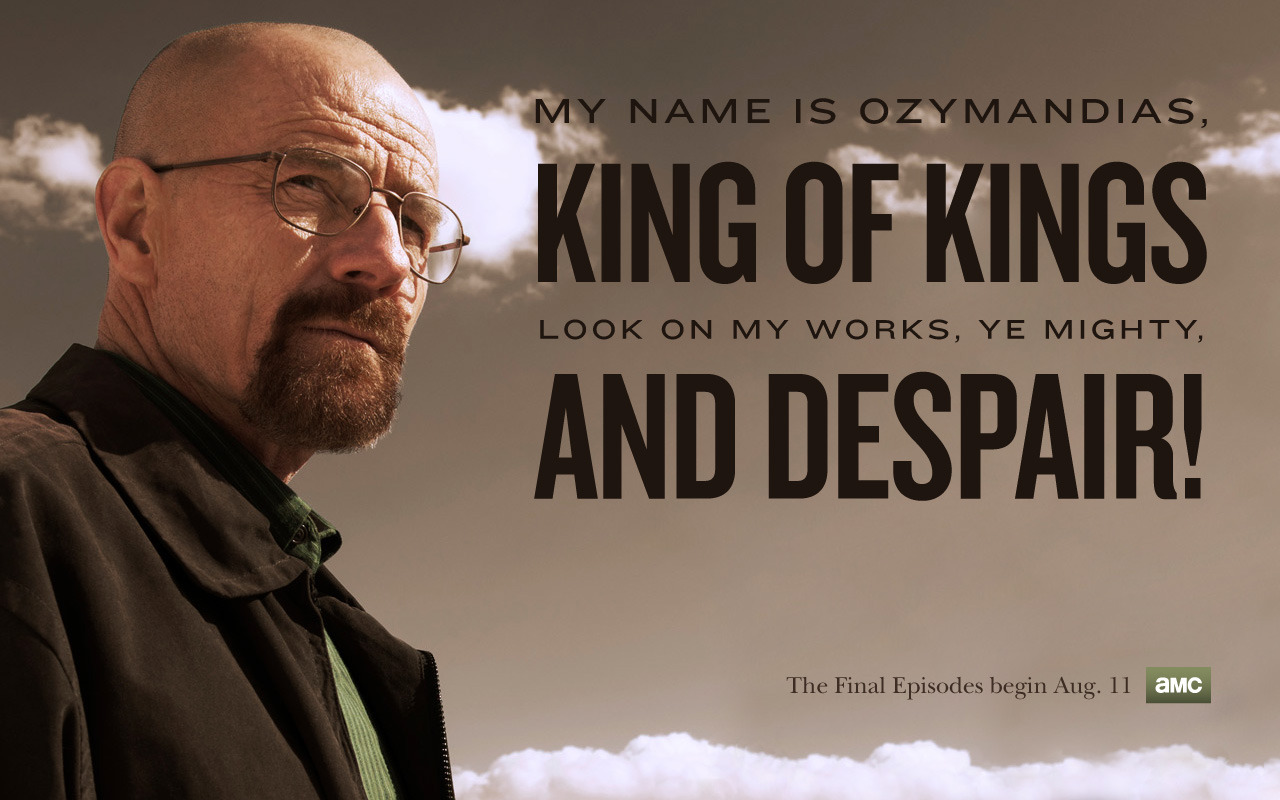
More than any episode in the history of Breaking Bad, "Ozymandias" came in with some pre-conceived hype and expectations. It features the return of Looper director Rian Johnson, who previously helmed the polarizing (beloved by me) season 3 episode "Fly, as well as the atmospheric (if a little less noteworthy) season 5 episode "Fifty-One". And then Vince Gilligan stated that he considered "Ozymandias" to be the best episode of the series, which gave it an enormously high bar. And well? It mostly pulls it off. "Ozymandias" is, without a shadow of a doubt, the best episode of this final stretch, and it's the full-blown climax of the series. Is it the best episode of the series? It might not be my absolute favorite (I still have a lot of love for "One Minute", "Face Off", and the aforementioned "Fly"), but it's definitely a top five all-time. As the picture above states, this is where Walt finally must accept the consequences of all of his heinous actions. Beginning with the death of Hank. Hank (and Dean Norris) is given a devastating and perfect final scene, where he refuses to beg Jack for his life, and tells Walt that for all of his brains and schemes, he can't stop a man like Jack from doing what he wants. And the cost of Walt believing he can talk or buy his way out of anything is nearly all of his money. Also, Jesse's life continues its downward spiral, as Walt coldly informs him of his role in Jane's demise, and he becomes Jack and Todd's slave meth cook, with Andrea and Brock's lives serving as his motivation. And then comes the destruction of Walt's ostensible series-long motivation: his family. Before we know it, he's abducting Holly, calling Skyler and absolving her of blame by leading the cops off her, and getting into a van headed for New Hampshire. In many ways, this is the end of Walter White's story, with the final two episodes serving as the epilogue.
"Ozymandias" gets a perfect 10.
Act IV (The Falling Action)
"Granite State"
Walter White is dead. Long live Heisenberg.
Walter White has dropped off the face of the earth, replaced with the nondescript and reclusive Mr. Lambert, who lives in a cabin in the woody boondocks of New Hampshire. "Granite State" represents a visual and emotional departure for the series, trading in the sand and cacti of the New Mexico deserts for the cold, icy snow landscape of New Hampshire (though it was probably actually filmed in northern New Mexico). As Shakespeare's final acts usually become simpler, shorter, and more pointed, so does the storytelling of Breaking Bad. "Granite State" is very much the "Brutus sees Caesar's ghost" episode of the season, as Walt finally comes to grips with how he's lost everything. Sure, he has that $10 million barrel of money, but what can he do with it? His family (exemplified by his phone call to Flynn that echoes an exchange from the first season: "Just die already") wants nothing of it, nothing that connects them to the now very public shame of Heisenberg. He can't really spend it, because he's mostly confined to his middle-of-nowhere cabin, lest he get caught. He can't entrust it to Ed, his vacuum cleaner-selling caretaker (cast perfectly with Robert Forster), as Ed points out that he would only be lying to himself to do that. All he can do is dole out small amounts of it to Ed to keep him alive, as well as paying him $10,000 to stay for an extra hour to receive some small vestige of human contact. And that represents the first sympathy I have felt for Walt in a long time. As much as he has dug his own grave, it doesn't make his fall any less heartbreaking. Walt is all set to give himself up and face the music (as Saul suggested earlier in his final appearance pre-Better Call Saul), when the Schwartzes appear on the bar television, telling Charlie Rose that he gave no contribution to Gray Matter, and that Walter White, the man they knew, is gone. And damn it, I got goosebumps as the theme started playing over the episode's close. Heisenberg now has nothing left to lose. Also, Jesse lost Andrea as his downward spiral of misery continues. Pre-finale, I wasn't sure what hope was left for him, other than my hope that he would get to kill Todd, that slimy, cold, emotionless robot. As the poster at the top says, the theme of this final season is "Remember My Name".
"Granite State" gets a 9.5 out of 10.
Act V (The Resolution)
"Felina"
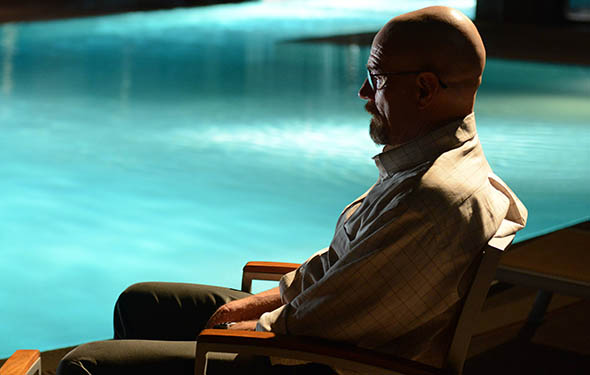
Walt in the shadows, as Heisenberg ascends.
As I said above, series finales are a tricky thing to pull off. "Felina" has a title with three meanings. One is an obvious example presented within the episode itself: The Marty Robbins song "El Paso", which Walt listens to in the car in the opening, and hums while later assembling his death weapon. Another is that it is simply an anagram for "Finale". And the third and most vague is that it can also be read as "FeLiNa" or "Iron/Lithium/Sodium", which, as many have pointed out, can mean "Blood, Meth and Tears". It is, without a doubt, the perfect title to the series finale of Breaking Bad. But did "Felina" pull it off? Did it fulfill the hype and expectations that come with being one of the most beloved television series of all time?
With one major caveat, yes. Yes it did. "Felina" is a riveting conclusion, one that ties up almost every single loose end left on the series' chain (It does leave a few things to mystery, though, with the primary one being Walt's grudge against the Schwartzes over Gray Matter, but that doesn't matter all that much) and delivers us an emotional and surprisingly cathartic ending to the journey of Walter White. While one might argue that catharsis isn't the right emotion to be feeling at the end of this series, I feel that Walt's change in behavior in this episode justifies it.
As I said in the photo caption, "Felina" could best be described as "Heisenberg's Ascension". And by that, I mean it is the fulfillment of Walt's character arc. Originally, Walter White was merely a mild-mannered high school chemistry teacher. He felt cheated by life, missing out on success and fortune that the Schwartzes received at Gray Matter, working at a job that he is extremely overqualified for and teaching students who couldn't give less of a shit about chemistry (including one Jesse Pinkman), and also working a demeaning second job where he is consistently browbeaten and emasculated by his boss. Couple that with a stable and loving but unfulfilling home life and an also more-successful-than-him brother-in-law, and you've got a recipe for someone on the brink. His lung cancer is simply the final straw that let the beast out of its cage. As Walt finally says to Skyler in one of the key scenes of "Felina": "I did it for me. I liked it, I was good at it. I was alive." I mean, most of us got the idea that by the time Walt was threatening rival dealers to "stay out of my territory", that he was enjoying himself, but it was clearly so Walt could finally have something (namely, money and power) that he had always felt cheated out of before. But with this rebirth as a criminal came some unsavory additions to his personality. He became a man self-obsessed with posturing and stroking his ego (look to the performative douchebaggery from "Confessions" or the bravado-laden speech from the opening of "Say My Name", or even his memorable quotes: "I am the one who knocks." "I'm in the empire business." "Nothing stops this train. Nothing."), and the showiness of his Heisenberg persona and porkpie hat. What "Granite State" taught him is that his shaven head, his hat, and his bravado can ultimately lead to nothing if put in a position with nothing left to lose. So, in "Felina", Walt's entire MO has changed. He's now hiding in the shadows and background of every scene. The Heisenberg legend has preceded him, so he no longer has to impress his enemies. He simply has to quietly intimidate them, or manipulate them into believing he's far weaker than he is.
That caveat I mentioned earlier is that the one fault of "Felina" is its predictability. I myself called numerous things that ended up happening in the episode (Jesse strangling Todd with his chains, Lydia being the ricin victim). But at the same time, it may be one of its strongest selling points. Walt's plan goes off without a hitch, and everything works out so predictably as he's planned because of the way he goes about it. When Gretchen and Elliott arrive home, Walt's sitting there in the shadows, not even immediately noticeable in the frame. He casually strolls into their home, allowing them to startlingly discover his presence there. He uses Badger and Skinny Pete (in one final appearance) to threaten them in a very lackadaisical way. He simply goes back to his old house and casually greets his neighbor Carol (as shown in the flashforward from "Blood Money") instead of hastily approaching the house armed (as he did in the opening of "Rabid Dog"). When Lydia and Todd enter the coffee shop, he's just sitting there at the counter and THEY DON'T EVEN NOTICE HIM. Jack and the Neo-Nazis don't even register him as a threat because of his weak and unkempt appearance. Walt has never tried to remain unseen before, so when he appears before them, they're basically in shock, allowing him to get one over on them quite easily. Gilligan (who wrote and directed this last installment) has Skyler talk to Marie on the phone, not choosing to reveal Walt's presence in the room until after she hangs up, leading to the "I did it for me" line, and an emotional last scene where Walt sees Holly for the last time, and watches Flynn enter the house from afar. Walt does bad things in "Felina", much as he has done in other episodes, but unlike many of the other instances, his reasons are actually altruistic. It's not exactly a full redemption for the character, but it does allow us to root for him in this final Heisenberg plan.
There is one single moment of improvisation in Walt's entire plan, and that is his tackling of Jesse to save him from the M60's bullets. Walt was angry that Jack had seemingly teamed up with Jesse for personal gain, after promising to kill him. But when he sees what Jack and Todd have done to him, he immediately reverts to his old role as Jesse's father figure, and saves him. It's Walt's best moment of the finale, and even manages to allow Jesse to nod at Walt, maybe not forgiving him, but coming to an understanding. And thus, Jesse drives off into the night, unexpectedly re-energized by surviving what seemed to be a hopeless situation. And I can't argue that the closing scene is basically perfect, as Walt admires the meth lab equipment while waiting for his bullet wound to bleed out (the only thing that may have made it better is if Walt tried the product, and said something like "A+, Jesse"). And of course, "Baby Blue" by Badfinger is the perfect song to close the episode.
"Felina" is not the best episode of Breaking Bad (it certainly isn't "Ozymandias", nor maybe even "To'hajiilee" or "Confessions"), but it is an honorable, definitive, cathartic, and oddly, sort of happy conclusion to the series. It doesn't praise or condemn Walt for his actions in the episode or the series as a whole, but it does allow him some small semblance of closure.
"Felina" gets a 9.5 out of 10.
More than anything, the finale ensured that Breaking Bad's legacy will not be tarnished. Its 62 episodes is one of the greatest modern stories, and is an example of television at its best. There may never again be anything like it.