Monday, June 3, 2013

Game of Thrones Mini-Recap: "The Rains of Castamere"

YOU WIN OR YOU DIE. No middle ground, indeed.
WARNING: MASSIVE SPOILERS AHEAD
.
.
.
.
.
.
.
.
.
.
.
.
Still here? Okay, then, last night on Game of Thrones, this happened:

Even as a book reader, Pregnant Belly Stab was DEVASTATING.
The Red Wedding. Non-reading viewers had no idea it was coming, and readers had basically anticipated it since the inception of the series. It's the crowning moment of George R. R. Martin's A Song of Ice and Fire, one where he says, "Ned's death didn't convince you that no one is safe? Well, TRY THIS."And it was amazing, devastating, and horrific all at the same time.

Not doing a full recap here, but just wanted to put my two cents in. I've found this season to be a little slower and less consistent than its predecessors (the perils of adapting only half a book), but "The Rains of Castamere" was uniformly excellent. With the exception of "Blackwater", it's at the top tier of the entire series.

And it may scare newcomer fans off forever.

Saturday, May 18, 2013

Star Trek Into Darkness Review

Damn that generic title. Luckily, it's the worst thing about it.
I'm a very rare breed of Star Trek fan in that director J. J. Abrams' original 2009 reboot Star Trek is actually what converted me to the franchise. Before that, I had always been a Star Wars stalwart, preferring Jedis, Death Stars, and grand pyrotechnics over the headier and more philosophical take on science fiction spawned by Gene Roddenberry. Then Abrams comes along, and suddenly, Star Trek very much resembles the other, with big action setpieces, musings on destiny and war, and a lot of good old-fashioned fun. After viewing it, I proceeded to watch what many (including myself) to still be the high watermark of Star Trek (give or take a "The Best of Both Worlds"): Star Trek II: The Wrath of Khan. Without ever having scene an episode of the television series, I was immediately drawn into the world of Kirk, Spock, and the moral quandaries, fearsome foes, and themes of life of death. As such, I have now seen most episodes of the TV series (along with the follow-ups), and all of the films. And Abrams' sequel, Star Trek Into Darkness, represents the first time I am entering a Star Trek film with prior knowledge of the larger universe. For many, this represents a bit of a test drive for Abrams, as he's (as I have previously discussed) been selected to helm the highly anticipated Star Wars Episode VII. After the photo, my response. (AND SPOILERS. IF YOU HAVE NOT SEEN THE FILM, DO NOT PROCEED. IT IS BETTER IF YOU DON'T KNOW ANYTHING GOING IN).
Um... what? Oh, right, right. The response. I was... distracted for a moment.
As I walked of the theater, my response was this: Star Trek Into Darkness is, for all intents and purposes, The Wrath of Khan in reverse. And this may not be as bad a thing as it could have been. Much of the hubbub surrounding this film was its secrecy, and the identity of the villain, played by Sherlock actor Benedict Cumberbatch (and an actor who I've wrote extensively about already). Guesses ranged far and wide, even after he was given the name "John Harrison". Many suspected him to be Khan Noonien Singh, the iconic genetically enhanced foe of Captain Kirk from the Original Series episode "Space Seed", as well as the aforementioned Wrath of Khan, previously portrayed by Ricardo Montalbán. Others put forth the name of Gary Mitchell, from the series' second pilot, "Where No Man Has Gone Before". Others still insisted (and hoped) he was a fresh antagonist, one we had no seen before. I was kind of hoping for a new enemy, but ultimately, Abrams' two Trek films to date have been primarily about putting a new spin on prior Star Trek iconography. Hence, Cumberbatch's "John Harrison" is actually Khan in disguise. This fits in perfectly with his two movies' inclusions of Romulans, Klingons, the original USS Enterprise, Captain Pike, Carol Marcus, Khan, Section 31 (I LOVED that the movie acknowledged Deep Space Nine, which is (IMHO) the best Star Trek show), and the Original Series crew, all updated and reinterpreted for a new timeline, the sole remnant of the previous series being the appearances of Leonard Nimoy's "Spock Prime". Star Trek Into Darkness is a flawed and deeply imperfect film, for reasons I shall get into, but it's also a ton of fun. It is roughly on par with its predecessor, with deeper valleys, but also higher peaks.

More than anything, though, I can describe the movie as thus: It ends with Spock fighting Khan Noonien Singh on a moving platform in downtown San Francisco, with Khan attempting to crush Spock's skull with his bare hands as Spock attempts to mindrape him. Seriously.

It is probably fair to accuse Star Trek Into Darkness of totally ripping off the plot of The Wrath of Khan, much like the lousy Star Trek: Nemesis (in general, the Next Generation movies mostly suck, with the possible exception of First Contact). However, it has many merits that the former does not. For one, instead of taking the hollow shell of Wrath of Khan and plastering a new sheen on it (as Nemesis did), it instead reinterprets the material, serving us up a far different storyline, as well as an extremely compelling villain (Tom Hardy is a great actor, but his Shinzon lacked basically any coherent motivation whatsoever). Many have complained that Khan is played by the British (and very Caucasian) Cumberbatch, as opposed to the Hispanic origins of Montalbán. Originally, Abrams sought Benicio del Toro for the role, which may have been a more accurate similarity, but I pose this question: If we can have a black Human Torch (as the rumors state for Josh Trank's Fantastic Four reboot), black and Asian Norse gods (Thor), and a Hispanic actor play the supposedly Indian-born Khan, then why can't a white actor essay the role? And especially when it's one as tremendous as Cumberbatch. MY GOD, Cumberbatch. Since watching Sherlock, I knew he was great, but I have a strong feeling that Star Trek Into Darkness will be his big breakout. He plays Khan as a mixture of the original incarnation of the character from "Space Seed" with Hannibal Lecter, as a master manipulator, genius intellectual, and truly worthy challenge for the Enterprise crew. CumberKhan easily outstrips Eric Bana's bland revenge-driven Romulan Nero from Abrams' 2009 film, and gives Montalbán a fair run for his money, even if he's not quite as iconic. For my money, though, Cumberbatch would have absolutely killed it as Q.

The rest of the cast also shows up, in fine form. Chris Pine continues his mastery of the cocky, arrogant, and young James T. Kirk, bringing his Han Solo-esque "never tell me the odds" mantra, but also giving him a new arc, as he matures into a more able leader deserving of his captain's chair. Abrams said that Star Trek Into Darkness would be about Kirk earning his command of the Enterprise, and that absolutely comes through. And as Kirk grows, so does his relationship with Spock. Where Spock dealt with his conflict between his human and Vulcan heritage in the last film, he now fights his conflict of emotions. He attempts to find peace in death early in the film, only to alienate Uhura. He has difficulty understanding Kirk's sense of camaraderie with him. However, when driven to a point, his emotions emerge, and he begins to act a bit more like his captain. And Zachary Quinto, too, is great. He's so good that he gives Leonard Nimoy a strong challenger, playing Spock a bit colder, but also with emotions that run deeper. And for Nimoy fans, yes, he pops up in a (somewhat gratuitous) cameo, which runs concurrent with one of the film's main flaws, which I'll get to. As for the rest of the cast, Karl Urban and Simon Pegg continue to provide excellent interpretations of Bones and Scotty, even if they are occasionally underutilized. Anton Yelchin's Chekov voice is great, though I wish his character had more relevance than serving as a Scotty stand-in for a large chunk of the movie. Peter Weller's Admiral Marcus serves as the secondary villain, and RoboCop plays him pretty damn well, as a militaristic leader hellbent on war. As for the female roles...well...I'm getting to them now. Abrams' direction is as good as last time, significantly elevating the holes in the script from writers Damon Lindelof, Roberto Orci, and Alex Kurtzman. Michael Giacchino's score is also consistently excellent, as his Trek theme continues to grow on me. The movie is also very well-lit, with Abrams doing away with many of his lens flares, and the editing keeps things fast-paced when the plot falters.

Now, on to the flaws, and while I think Star Trek Into Darkness rises higher than its predecessor, it also sinks lower. It changed my directorial perception of Abrams as a man who never takes risks, because in the last act of this film, he took some HUGE ones. Some stuck, and some don't.

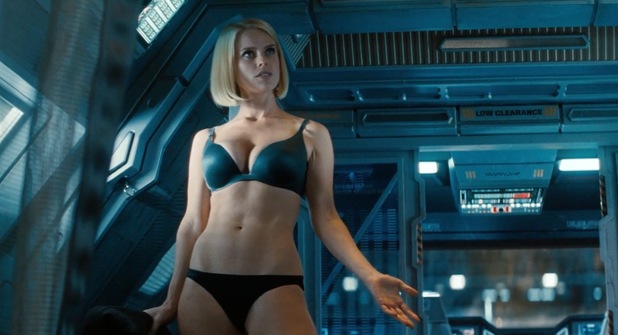
- The Female Characters: The two main female characters in the movie: Zoe Saldana's Uhura and Alice Eve's Carol Marcus, are both woefully underused and misused. Uhura's only purpose is to be an angry girlfriend to Spock, talk to Klingons, and to shoot Khan in the final fight. Other than that, she may as well have not been there at all. This is even more egregious with Marcus, introduced ostensibly to serve as Kirk's love interest and to tell more on the new torpedoes, only to spout expository dialogue and occasionally show skin (see picture above). For a series that has given well-drawn characters of both genders in the past, it falters heavily here.

- A Convoluted Plot Riddled with Holes: As much as I think the general idea of the movie works, it just remains that the plot is messy, and has many oversights. For one, Kirk is being sent back to the Academy, then he returns as First Officer, then he's Captain again because Pike is dead, and he's going after CumberKhan on Kronos with Advanced Torpedoes that do... what? Then they fight Klingons and CumberKhan on Kronos, then capture him, then fight the Vengeance, then take it down from the inside, then fight Khan, then save the ship from crashing, then Spock chases Khan and fights him, and so on and so forth. Too many threads in this movie with too many of them being underdeveloped. This is clearly Abrams' attempt to do a classic Star Trek movie style plot, with many threads and twists and turns, but it's just too twisty. Khan's a bad guy, then a prisoner, then an antihero, then a villain again, and the full intricacies of Admiral Marcus' plan are never fully explained. Then there's the transwarp beam that Khan uses to get from his shuttle in San Francisco to Kronos. MY GOD. If that tech exists, WHY ARE THERE STILL FRIGGIN' SPACE SHUTTLES??!! Also, did Khan's blood Lazarus serum just remove all consequences from any Star Trek movie, ever, or was it a one-time plot device to resurrect Kirk that will never be mentioned again?

- A Massive Overabundance of Fanwank: The third act of this movie moves from "Same villain, different plot" into straight up homage territory with The Wrath of Khan, and in attempting to please fans, it goes too far. Direct line callbacks, the presence of Carol Marcus despite her being generally unneeded, McCoy's constant "I'm a doctor, not a..." lines, and the Enterprise facing off against a secretly commandeered Federation ship. But as I said above, it does it in reverse. And while I actually like the clever reversal, it attempts too much. Spock faces off with Khan on the ship's bridge, while Kirk goes into the radiation chamber. Kirk saves the ship, but is fatally hit with radiation poisoning. The glass separation. "Ship? Out of danger." "I'm your friend". The hands touching against the glass. Kirk slumps over and dies. And, in the movie's silliest/greatest moment, the music swells, Spock coarses with range, and he.....

KHAAAAAAAAANNN!!!!
While, arguably, Quinto's delivery of the line is great, and he really sells the emotion in it, it doesn't change that it totally feels ridiculous.

But again, despite the plot issues and the fan wanking, I enjoyed the hell out of Star Trek Into Darkness. The movie's deeply flawed, but it also succeeds at Abrams' winning streak of making superbly entertaining blockbusters. If Star Wars Episode VII is as good as this, I will be sufficiently pleased.

Star Trek Into Darkness gets a 7.5 out of 10.

When exactly did they trek into darkness? Or anywhere?
Also, for the third film, whether Abrams directs it or not, my bet is on the Borg. You could have Kirk and crew go out into to space, and maybe the Borg were drawn in by the destruction of Vulcan. Kirk and Spock never faced the Borg, so while still culling elements from prior incarnations, it could indeed be very interesting. Just leave the Borg Queen out; they're more threatening when they're faceless.

Sunday, May 12, 2013

Iron Man Three Review

Tony Stark meets Johnny Gossamer. God, I wish they sold this masterpiece.
Saying that Marvel Studios had a tough act to follow this year is a bit of an understatement. Not only was The Avengers the highest grossing superhero movie of all time, but it also deserves the honorable title of being the highest grossing film not directed by James Cameron. Phase One of the Marvel Cinematic Universe ended with a bang. But because money, the wheel continues into Phase Two, offering up the potential for some new superheroes, as well as to allow some new filmmakers to step into the comic book movie pot. And since Marvel needs to make sure Phase Two starts successfully, they began by returning to the original source of their universe's success: Iron Man. Robert Downey Jr. is perfectly cast as Tony Stark, so much so that I never want to see anyone else play the role (despite the inevitability that it will happen, as producer Kevin Feige has already speculated on "James Bonding" it once Downey has had his fill), and director Jon Favreau served up a great comic book movie in his own right back in 2008. However, the 2010 follow-up, Iron Man 2, was more problematic. While still being eminently watchable and entertaining, the sequel was stuffed with forced Avengers tie-ins (to the point of feeling like a 2-hour commercial for it at times), subplots, weak villains, and a rather skimpy amount of action. Needless to say, after this, Favreau decided to back out of directing the third film. However, in his place, a far more exciting filmmaker was selected: Shane Black, writer of the first two Lethal Weapon movies, and director of the underseen and underrated buddy-crime-comedy, Kiss Kiss Bang Bang. Downey was the star of the latter, and it is credited as one of the movies that helped resuscitate his drug-hindered career, so it was only natural that Black be in the running. And now, we finally have the beginning of Phase Two, Iron Man Three (as Black refers to it in the end credits sequence). My response to the movie itself after the jump.

This looks... familiar.
As the above picture implies, yes, in some ways, Iron Man Three is the Tony Stark version of The Dark Knight Rises. Both films attempt to bring both the plot and arc of the character full-circle, and to tie up the loose ends from previous films. However, Black's interpretation of this fulfillment of the character's story is quite a bit different from Nolan's, as I will explain. 

SPOILERS AHEAD. TURN BACK IF YOU HAVEN'T SEEN THE FILM, OR READ ON AT YOUR OWN RISK. THOU HATH BEEN WARNED.

From the Marvel fanbase, Iron Man Three has been receiving quite a bit of backlash, particularly for three reasons: the alterations to the source material (in particular, the film's interpretation of Iron Man's archenemy, the Mandarin), a recurring focus on comedy over superheroics, and the lack of Iron Man action. 

When it comes to the first caveat, I totally understand for hardcore Iron Man comic fans, but I am not one of them; as such, I have no emotional attachment to their interpretation of the Mandarin. On the whole, I found the reveal of Ben Kingsley as drunken actor Trevor Slattery to be a genuinely surprising and hilarious twist. Really, when "the Mandarin" first appeared, looking like the most generic copycat terrorist ever, started talking about a bombing in Kuwait, and then awkwardly muttering "I... I did that", you didn't suspect something a little fishy was up? Yes, I know some people wanted Tony Stark to duke it out with ten magic rings, but that wouldn't have fit with what Black was trying to do here.

For the second and third angles, I present this definite, inarguable fact: Iron Man Three is a Marvel Studios movie filtered through the lens of Shane Black. It's Kiss Kiss Bang Bang with superheroes.

It's got all of Black's fingerprints on it: the Christmas setting (Lethal Weapon, The Last Boy Scout, The Long Kiss GoodnightKiss Kiss Bang Bang), the buddy cop/action-comedy formula (Lethal Weapon, Lethal Weapon 2, The Last Boy Scout, The Long Kiss Goodnight, Kiss Kiss Bang Bang), the Johnny Gossamer-esque pulp mystery style (again, see the above poster), and the goofy comedy. And all of this is then thrown into the Marvel Cinematic Universe, with Tony Stark dealing with PTSD after the events of The Avengers, and bringing back the question Steve Rogers asked him in that film: "Big man in a suit of armor. Take that away, what are you?" At the time, Stark wittily answered "Genius billionaire playboy philanthropist", but that question may have hung on him. And thus, the central question of Iron Man Three is posed: Does the man make the suit, or the suit make the man? And by the end, we have our answer. Which brings me back to my two latter points. In regards to the overabundance of comedy, that question is not only answered by Black's style, but by the fact that the movie was mis-marketed. Don't believe me? Let's check out that first trailer from last October again:


Yep. A little darker than the final film, ain't it? This trend continued all the way until the film's release, where people were basically blindsided by the overabudance of Blackisms, from the goofy one-liners to the Riggs-n-Murtaugh relationship between Tony and Rhodey. Same goes for Harley, the kid. Normally, the introduction of the kid would be a kiss of death, but Ty Simpkins is no Jake Lloyd, and Tony's rather frank and rude treatment of Harley circumvents the normal pitfalls, making the kid's precociousness funny instead of grating. As for the lack of Iron Man action, that would run counterproductive to the film's themes. By keeping Tony in Tennessee, and having him solve the mystery of the Mandarin like a Johnny Gossamer, they make him a real hero, as opposed to just a narcissist in a power suit. There still is Iron Man stuff, like Tony's visually stunning rescue of the passengers of Air Force One, as well as the spectacular shipyard climax, it's just not the focus of the movie. As for the complaints about the Extremis soldiers tearing off Tony's armor (when Thor, a demigod, only managed to bend it), the Mark XLII and his Iron Legion were mostly prototypes that he was still tinkering with. His original seven suits (the ones he built and used during Phase One) were all destroyed in the helicopter attack. The power levels are still a bit off (as they were in The Avengers, where a gamma-powered Hulk was able to toss Loki, another demigod, around like a rag doll), but it never gets in the way of the overall movie. 

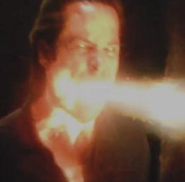
The actors, are, of course, great, as they always are in the Marvel Studios fold of films. Downey delivers what may be his most complete performance as Tony Stark yet, one that only affirms his vital importance to the character, giving us his snarky and vulnerable sides, sometimes at the same time. Gwyneth Paltrow is given more to do here than she ever has as Pepper, and while it may not be up to her previous performances in the role, she sells the more interesting bits of this outing (Super Pepper). Don Cheadle proves me wrong, with a far superior performance to his bland outing from Iron Man 2. By giving him and Tony a buddy-cop dynamic, they overcame the weaknesses of the character, allowing Cheadle to overtake Terrence Howard from the first film, and making Iron Patriot (despite not being as cool a name or look as War Machine) pretty damn cool. Guy Pearce has the toughest role of the film, as the biggest weakness of Iron Man Three is the lack of depth from Aldrich Killian, the true "Mandarin" and the film's real villain. However, it says something that I don't even mention the film's real villain until way late in the review, as there just isn't much there. Killian basically wants revenge on Tony just for leaving him waiting out in the cold. And while some weak argument of his "desperation" is presented later, I just never understood the quantum leap from meek, disabled nerd to Extremis-enhanced douchebag. For sure, Pearce's douchebagginess is entertaining as hell (especially when Killian's creeping on Pepper), and that part where he breathes fire is the single greatest moment in cinematic history, with Ben Kingsley as Slattery going "Oley, oley, oley oley!!" running a close second. Here's a picture, just to refresh your memory of the moment where Aldrich Killian from Warren Ellis' Extremis meets the Mandarin meets a Fin Fang Foom:

Seriously, this is AMAZING. Screw the haters on this one.
But, yeah, as I said, Killian's motivations just aren't that convincing. Neither are those of the Extremis soldiers (other than Stephanie Szostak's Brandt), despite James Badge Dale also being an entertaining glowing douchebag. Though I do appreciate the attempts to fit in Coldblood and Firepower, two obscure Marvel villains who probably otherwise would never have seen the light of day on film, making them into glowing monsters doesn't entirely work. As for Maya Hansen, she's probably the weakest character in the film. She was the secret villain of the entire Extremis story arc, and she's basically wasted here. Her motivations change twice, and she dies like a punk, thus robbing us of any emotional investment in her character. I honestly don't know why they bothered to cast Rebecca Hall, as a far less exceptional actress could have done the same job she did for way cheaper. Apparently they cast Jessica Chastain first, which is even more insane. In general, the villains are by far the weakest part of the movie, as they have been in both previous Iron Man films (Jeff Bridges' Obadiah Stane was interesting until he became a generic evil robot pilot, and Mickey Rourke's Whiplash was quirky but completely ineffectual).

As for the technical stuff, Brian Tyler's score is excellent. Tyler's a great composer who's been stuck in the doghouse until now, scoring movies like AVP Requiem and Battle LA, and he establishes himself here, not only crafting a great soaring theme for Iron Man that's he's been sorely lacking until now, but also giving us the backdrop for Black's virtuoso end credits sequence, the fantastic 60s-Batman-esque "Can You Dig It?". See here: http://www.hypable.com/2013/05/07/iron-man-3-end-credits-sequence-officially-released-in-hd/ . John Toll's cinematography also crafts my favorite look for an Iron Man film yet, far more bright and colorful than the more streamlined work from Favreau's films. 

My verdict: Iron Man Three is the third-best film in the Marvel Cinematic Universe, after The Avengers and the original Iron Man. It's a BIG step up from Iron Man 2, and may be the most cleverly funny superhero movie ever. Ben Kingsley is easily the best thing in the film, as he plays both shades of his role so damn well. Black was an inspired choice, and other than some weak villains (and the curious lack of S.H.I.E.L.D., which Feige said will be explained in the upcoming Captain America: The Winter Soldier), this is a rollicking good time at the movies. It comes highly recommended.

Iron Man Three gets an 8.5 out of 10. 

I'll see you again in Phase Two come November, with the release of Thor: The Dark World.

Also,  Mark Ruffalo showing up was pretty cool.


Wednesday, April 3, 2013

BioShock Infinite Review

You have no idea...
NOTE: SPOILERS FOR ALL THREE BIOSHOCK GAMES FOLLOW.

Way back in summer 2011, I posted an article in which I discussed the current state of the BioShock video game franchise, expressing my love for the first and general ambivalence for the second. Irrational Games' original vision of the underwater city of Rapture remains one of the most captivating video game experiences of all time, and its 2K Marin-developed sequel, while fun and worth playing, amounts to little more than a tack-on. However, a few months after the release of the aforementioned BioShock 2, Irrational announced that their secret project, formerly codenamed Icarus, was in fact the next installment of the franchise, titled BioShock Infinite. However, it eschewed the concept of what a sequel usually is, trading in a well-worn retread of Rapture for the high-flying sky-city of Columbia, and jettisoning most of the franchises' most iconic features, from the city itself, to Big Daddies, to Little Sisters, to Splicers. Game director Ken Levine stated that while "the core" of what makes a BioShock game BioShock was still there, from the unfamiliar setting to the still-solid FPS/RPG hybrid gameplay. Plasmids became Vigors, Tonics became Gears, and EVE became Salts. And so, fans salivated for two and a half years, and a few delays, in anticipation of its release. Check to see of BioShock Infinite was worth the wait after the jump, and the requisite GIF:

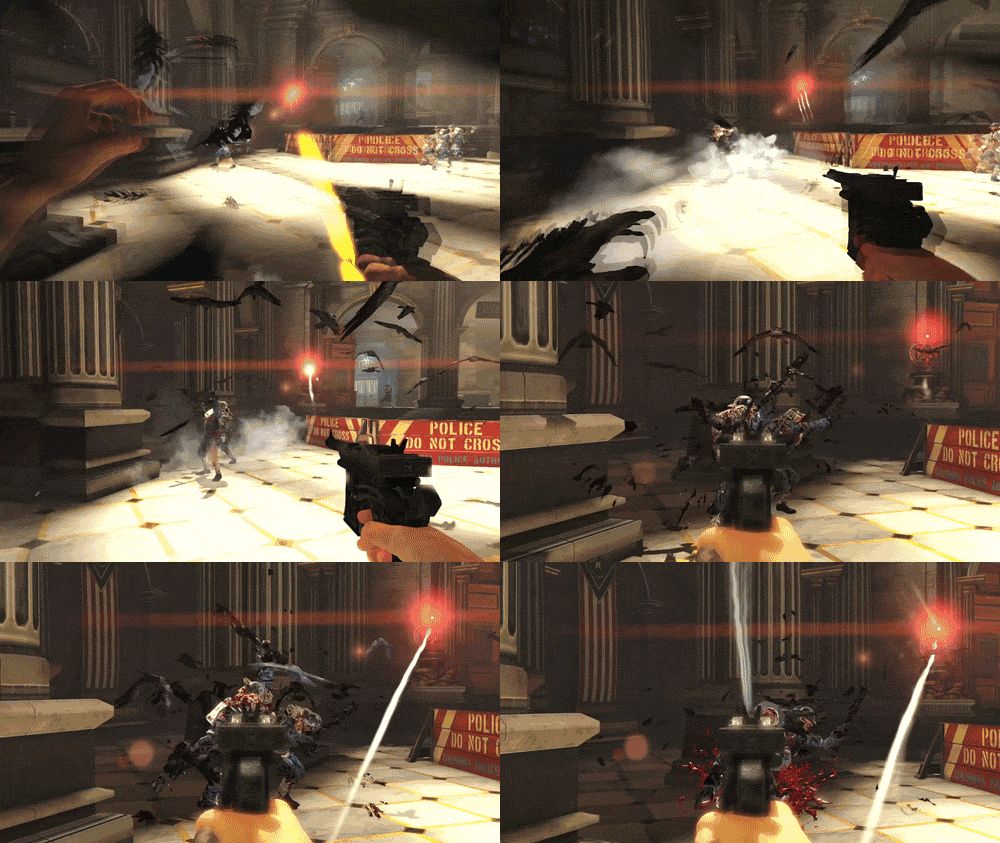
I. LOVE. MURDER OF CROWS.
BioShock Infinite is a masterpiece. There's no way of getting around that. Levine has created a game that ascends to the level of the original, and possibly soars above even that. It gives this series not only a shot in the arm, but it actually (and wonderfully) redefines what exactly this series truly is, from a narrative standpoint. The core gameplay is basically the same, with the same deal of shooting, powers, scrounging, collecting, and general mayhem. But it's in the story, the one area where BioShock 2 ulitmately fell flat, that Infinite truly rises to the occasion. On the initial surface, the story of ex-Pinkerton Booker DeWitt attempting to retrieve a girl, Elizabeth from the sky-city in order to clear some mysterious debts sounds simple enough, but as the plot progresses, the narrative becomes increasingly complex and labyrinthine, introducing Elizabeth's powers (the "tears"), the Songbird, the antagonist of the Prophet, Zachary Comstock, the Vox Populi resistance led by Daisy Fitzroy, and Booker's past. But when you think about it, nearly every single element of the plot has a direct comparison to the original BioShock. This is intentional on the part of Levine, as it allows him to truly get at the meat of his ideas. Jack, the outsider thrust into the mad, mad world of the city, is Booker. Comstock, the cultish leader who built the city due to his disagreement with the world's ideals, is Andrew Ryan. Daisy Fitzroy, the revolutionary who ultimately plays a role in the city's downfall, is Atlas/Fontaine. The Songbird is like one giant Big Daddy, with Elizabeth as his Little Sister. The Lutece twins are Dr. Tenenbaum.  To replace the threat of the Big Daddies as mini-bosses, we get the Handyman, and the Motorized Patriots. As Andrew Ryan conveyed his Objectivist ideals through his secluded underwater Art Deco metropolis, Comstock forces his hyper-fundamentalist and nationalistic cult (to a racist, insane fault) into every pore of his airborne Kensington. And just as in Rapture, not all in Columbia is as it seems.

For a large portion of my time spent with Infinite, I was essentially giddy with joy at the wonder that Levine had put in front of me. And yet, I felt like something, just SOMETHING was missing. I felt like that when I looked back on the game in future years, it would not be as indelibly printed on my brain as the original BioShock. Was Slate or Fink as memorable as the mini-bosses of Dr. Steinman and Sander Cohen? Was any area of Columbia as unforgettable as Rapture's terrifying Medical Pavilion? I was unsure; the only things that I felt would remain on my brain long after putting the controller down were Elizabeth, the Songbird, the Luteces, and Comstock. The only real wrinkle was the tears. I figured the game would have a neat twist at the end, a parallel to the still-gut-punching "would you kindly" twist from the original, probably to do with the tears. And I figured I would say it was great, but not as good as the original.

But I didn't get one game-ending twist. I didn't get two, or three, or four, or zero. I got, well, Infinite.

SPOILERS FOR THE ENDING FOLLOW.

So anyway, in the final act of the game, Booker drowns Comstock in his little baptismal pool/birdbath thing, and him and Elizabeth seize control of the Songbird in order to destroy the final threat of the Vox Populi, before finally leaving Columbia forever. They successfully utilize the Songbird's power to destroy their opposition, but then Booker loses the controls. Songbird immediately comes after him, forcing Elizabeth to transport them through a tear, to an entirely different place. Where, you ask? (LAST CHANCE TO AVOID SPOILERS)

Elizabeth rejected Columbia. Instead, she chose something different. She chose the impossible. She chose... RAPTURE.
That's right. Rapture. They took a tear into Rapture. At this point I practically exploded with pure fanboyism delight, as Booker and Elizabeth took the reverse out of Rapture in the bathysphere, the same way Jack came in in the original game. Booker makes a comment about the ridiculousness of an underwater city, and I explode with joy. And then, Twist #2 (or Twist #Infinite) arrives:

Ah. I get it now.
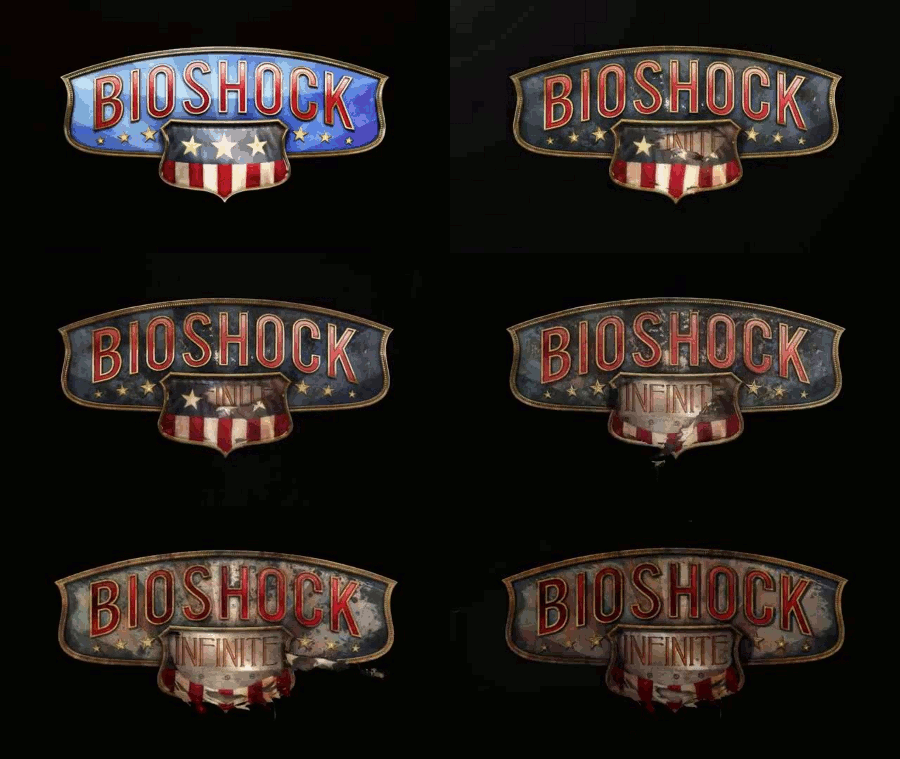
And thus, the true meaning of the title BioShock Infinite comes to the surface. Levine said he meant for it to refer to the "infinite possibilities" of the game concept. I thought that was dumb, because it meant that they were naming the second game in this high-concept idea Infinite when others may come afterwards. However, I now get that Levine's a game goddamn genius. Infinite really means that through every tear, every permutation of every possible universe, there are a million different BioShocks out there. A million different strange worlds, all entered through a lighthouse.

Um.

MIND BLOWN INFINITE TIMES
I see now what this is. Maybe Comstock was right, after all. Maybe this ending is divine retribution for the end of Mass Effect 3, which took a series with thematic depth and complexity equal (and possibly surpassing) the BioShock franchise, and then dumbed it down to a alien RoboBaby's choice of red/blue/green explosions.

And the thing is, there's still like, 20 minutes left in the game at this point, in which there are multiple more twists, one in the last 30 seconds of the game, all of which completely re-contextualize everything that came before. It's like infinite "would you kindly"s, back-to-back-to-back. None of them probably reach the single sheer brilliance of the original game's big twist, but unlike the original game, they all know how to follow up from there, whereas the original sort of lost its way in the final acts post-twist, culminating in an unnecessary Big Dumb Boss Fight.
This guy ain't half as threatening as one Big Daddy.
Sure, the ending(s) that came after that were great, iconic even, but Infinite doesn't trivialize. Rather than having you fisticuffs with an elderly Comstock, or having you fight the Songbird or something ridiculously implausible (like a guy ADAM-ing himself into mutant land like good old Atlas pictured above), they throw Columbia's kitchen sink at you, and force you to very quickly strategize your victory, leading to the utter NPH-mindblowing awesomeness described earlier. Also, the game has one, definitive ending. Levine was clearly more interested in a standalone story here than a morality play, and because Booker's ending is his own redemption in and of itself, multiple endings would muddle the impact.

So yeah, I liked this one. 2013 Game of the Year? Maybe, but it's a bit early for that. This year, after all, does also have The Last of Us, Grand Theft Auto V, and the launch of the next generation of consoles. Does BioShock Infinite hold up to the previous GOTY (IMHO) of this generation? Is it better than the original BioShock, Grand Theft Auto IV, Uncharted 2: Among Thieves, Mass Effect 2, Batman: Arkham City, or Telltale's The Walking Dead (which, again IMHO, is 100x better than the TV series)? Well, it certainly belongs in that pantheon. And it probably doesn't best Levine's original, if only because it cribs its entire gameplay framework from the former. Nevertheless, it's a game that EVERYONE should play, as with that ending, there's nothing quite like it.

BioShock Infinite gets full marks.

Meathead DudeBro pandering on one cover, pure art on the other.

Monday, April 1, 2013

Game of Thrones Season 3 Recap - "Valar Dohaeris"

WHERE ARE MY DRAGONS??!! AND MY STRONG BELWAS??!!
Note: SPOILERS for up to and including A Storm of Swords may follow. You hath been warned.

I'm going to open this review/recap with a not-so-bold guess:

Season 4 of Game of Thrones will ultimately be the best remembered of the series. That's right, 4, not 3, and I'll explain why.

Two years ago, I almost started a weekly blog post about the HBO TV series based on acclaimed fantasy writer George R. R. Martin's epic fantasy novels, A Song of Ice and Fire. However, I ended up deciding that the show's audience, that being that of a genre series on premium cable, was too small for me to want to weigh in. "This isn't like some big summer blockbuster like The Avengers or The Hobbit", I thought. "This is just a niche genre show that no one but fantasy fans and book fans will see". And now here I sit typing in 2013, and I couldn't have been more wrong. Now, Game of Thrones is a cultural phenomenon, and one shared by the mainstream. Despite the narrative and thematic complexity, the high audience expectations, the somewhat audience-limiting fantastical elements, and the sprawlingly enormous cast of characters, more and more people continue to tune in, and more and more people are enthralled. Even more importantly, people that don't normally read on a regular basis are picking up and reading the massive books (myself included). Thus, I already have a general idea of what's going to happen in this third season, based on the first half of Martin's A Storm of Swords.

Now, back to my prediction (though I've already noted here that my predictions are often proven wrong). It just so happens that A Storm of Swords is also my favorite book so far in A Song of Ice and Fire. I have not yet had the opportunity to read A Feast for Crows or A Dance with Dragons, so that may change, but for now, the third volume is my favorite. The first two seasons were both brilliant distillations of A Game of Thrones (a very direct adaptation) and the more sprawling and difficult A Clash of Kings (more alterations that ultimately mostly made the series better for it). However, A Storm of Swords is so massive that showrunners David Benioff and D. B. Weiss have decided that it needed two seasons to be properly told, and I couldn't agree more. I feel even more confident of this upon viewing tonight's season premiere, "Valar Dohaeris". However, while the climax of this season, if it is as it was in the book, will indeed be earth-shattering (as well as a springboard for the events to come), especially for the non-readers who found Ned Stark's death in "Baelor" shocking, season 4 will contain most of the real meat inside A Storm of Swords. That isn't to say that this season will be any slouch, though, and though "Valar Dohaeris" will probably never be anyone's favorite episode (like last season's premiere, "The North Remembers", it has much to do and only so much time to do it, and less thematic material to link the threads together), it nevertheless remains a solid welcome back into this world. On to the recap, after the jump (and my favorite GIF of all time):

People who were bored to hell with Dany last season will be happier here.
I was hoping "Valar Dohaeris" would begin right where last season's finale, "Valar Morghulis", (big ass wink for readers, as well as a thematic bridge for the episode with the "all men must serve" thing, but it's just weird to me that an episode with this title wouldn't include Arya) left off, and I wasn't disappointed, as we cut to Samwell Tarly being saved from a Wight by the Lord Commander. And yes, we didn't get to see any of the Others' attack on the Fist of the First Men, but this is a TV show with a limited budget, so I'll give that a pass, much as I'll pass Tyrion getting knocked out right at the start of the battle in "Baelor". After we deal with this, as well as Jon Snow meeting Mance Rayder, The wildling King Beyond the Wall (Ciarán Hinds will be AWESOME on this show, by the way, even if he isn't exactly my mental picture of Mance), we spend most of the rest of the episode either in King's Landing with the Lannisters and Sansa, on Dragonstone or elsewhere with Davos, Stannis, and Melisandre, or across the Narrow Sea with Daenerys and Jorah. And I must say, it's good to see Peter Dinklage as the newly scarred Tyrion again, even if he was keyed down a bit in this episode (though he did get one great line about how he "sometimes drank with the harlots"). His situation is quite a reversal from last year, what with daddy Tywin holding him in an iron grip, and him being essentially powerless, with his lovable sociopathic sellsword/friend Bronn demanding even more money out of him for protection. I could talk about how some scenes are pitch-perfect book-adapted all day (The Tyrion-Tywin scene is nearly word-for-word from the pages of the novel, as is the hilarious exchange between Daenerys and Astapor slaver Kraznys mo Nakloz), but the scenes I'll talk mostly about in these recaps are the ones wholly invented for the series:

1. Bronn getting it on in the whorehouse. Usual GoT-style nudity/exposition, though it is kind of funny how he viciously threatens to murder Pod for interrupting him.

2. Tyrion and Cersei talking in his quarters. Set-up for the Tywin-Tyrion scene, usual Tyrion-Cersei back-and-forth, just like last year. Great stuff from Dinklage and Lena Headey, as usual. It's followed up by a scene with Tyrion and Bronn that's technically not in the book, but is basically the same stuff.

3. Robb, Cat, Talisa, and Roose Bolton at Harrenhal. Apparently, after Arya, Hot Pie, and Gendry escaped last season, the Lannisters abandoned Harrenhal, and the Mountain, Gregor Clegane, left 200 slaughtered Northmen behind. At this point in the book, the Starks, under the command of Bolton, had already taken Harrenhal in A Clash of Kings, with Arya escaping after they had already occupied it. Presumably this scene is there to A) Remind us Robb is a person, who married for love and not duty, and is still at war with the Lannisters; B) Remind us that Cat released Jaime last season, and is technically being considered a prisoner; C) Lord Karstark is PISSED; D) Allow Bolton to hold Harrenhal, so he can be in command when Jaime and Brienne arrive later; and E) Introduce Qyburn, a character included in A Clash of Kings but omitted last season, who becomes more important later on. As important as this scene is narratively, thematically all I can muster is an "Eh"

4. Shae, Ros, Sansa, and Littlefinger at the docks. Despite Ser Dontos showing up in last season's premiere, it's clear now that his role as Sansa's "savior" has been wholly transferred to Littlefinger, and that's fine by me. More Littlefinger the better, I say, and the fact that Sansa's still willing to trust anyone is a critical mistake on her part, though at least she's learned that she sucks at lying. Meanwhile, Shae and Ros talk about how far they've come and their service to their employers, which is a good showcase for how great these two mostly invented characters are. Shae was in the book, certainly, but her strong-willed goodness is a trait exclusive to the show, which not only makes her a far more interesting and likable character, but also makes me wonder how the writers are going to handle her departure, as her death in the books probably won't fit. Ros, on the other hand, is a composite character of a million different characters who suffered misfortunes in the series, and she has also be surprisingly well-done. Also, HOLY SHIT LITTLEFINGER RECOGNIZED ARYA WHEN HE WAS MEETING WITH TYWIN LAST SEASON AND DIDN'T SAY A GODDAMN THING. THAT SLY BASTARD.

5. Daenerys and her dragons on the boat to Astapor. While there was a scene on a boat in the book, it was under much different circumstances (Dany had already teamed up with "Arstan Whitebeard" and Strong Belwas (more on him later), and was sailing for Pentos when she suddenly decided to change course to Astapor), but still serves the same narrative purpose. It was a nice touch to have the Dothraki puking everywhere, with them never being on the water and all, and flowed nicely from the promise of them buying a ship at the end of last season. Also, the CGI dragons are probably the best CGI in television history. We're talking near-summer blockbuster quality here.

5.  Davos directly confronting Melisandre. This scene was FANTASTIC, possibly my favorite of the episode (except for maybe Dany and Kraznys). In the book, Davos was arrested for plotting to kill Melisandre upon arriving at Dragonstone; here, we get a direct confrontation where he tries to knife her in the back and IS DRAGGED OFF SCREAMING MADLY. Stannis is clearly not all-there after his scene (also invented) in last year's finale, as he has come to trust only Melisandre, and burns anyone alive who disagrees (as in the book). But, yeah, this was great. I love Davos Seaworth, and his stuff in this episode, where he continues to try to save Stannis from himself, continues to be awesome. Liam Cunningham nails it perfectly, too.

6. Joffrey in his Kingcage, Charitable Margaery in Flea Bottom, and dinner with the royal family. This scene was a good thread from last year's pragmatic Margaery, who not only wants to be "the queen", but also apparently a beloved one, as she does everything she can to make the smallfolk of King's Landing forget that Joffrey's such a hateful little shit. Meanwhile, Joff, apparently fearing another attack of the cow pies, hides in a little carried King-mobile with flaps in order to talk to his Kingsguard. I seriously love that Joffrey's afraid to leave his little carrying case in public, as it highlights what a two-faced big-talking coward he is, and the more Coward Joffrey the better, I say. Meanwhile, I also love that he seems so timid around Margaery. When he's betrothed to an innocent like Sansa, he's a torturous little devil, but when he's engaged to a smart, capable woman who knows how the game is played, he becomes this clumsily mannered stammering simpleton. Also, Cersei dressing in Tyrell-style garb to kiss ass, presumably to Ser Loras, who's probably her next conquest in using her "best weapon" (Though he may have a hard time getting past the whole "she was married to his former gay lover's fatass king brother").

7. The Reintroduction of Barristan Selmy. In A Clash of Kings, a scene much like this happens, only Ser Barristan introduces himself as "Arstan Whitebeard" and he is accompanied by an enormous black eunuch named Strong Belwas. Later on in A Storm of Swords, which would have most likely taken place in season 4, he is outed as the former Lord Commander of Robert Baratheon's Kingsguard. Here, due to the fact that anyone with a brain would recognize Selmy from season 1 (presuming they remember him), they wisely dispose of that plot twist (though I practically leapt with excitement after reading it in the book) and simply introduce him outright. This is fine, but goddamn it, if Belwas doesn't show up at some point it will be a severe disappointment.

Other things:

- They redesigned the opening credits once again to re-include Dragonstone, as well as introduce Astapor as the new closer replacing Qarth. The animation for Astapor is damn impressive. Also, Oona Chaplin (Talisa) and Rose Leslie (Ygritte) have been upgraded to main cast members. Curiously, Ciarán Hinds (Mance) is not in the credits, so presumably, we may not be seeing him often.

- That giant in the wildling camp was also awesome, as was the introduction of Tormund Giantsbane.

- No Arya, no Jaime, no Brienne, no Bran, no Theon (though when he'll show up again, I have no idea), no Hound, no Varys this week. I feel that Arya's storyline has been tamed a bit (no killing the guy with Needle at Harrenhal's gates, and we already know that she won't kill the Tickler), but it's still too early to tel, so we'll just have to see how exactly she gets onto that Braavosi ship. Also, I needs more Jaime and Brienne. NOW. I didn't really miss Bran or Theon, though, but they've changed so much in their storylines (No Ramsay (yet), no Reeds (but we know they're coming), and Bran and Rickon are still together) that I have know idea what's going to happen next there.

- That nipple cutting-thing.... I know we've seen dudes' heads cut off and everything (hell in the COLD open (LOLZ), we see a man of the Night's Watch with his head in his hands), but that was just nasty.

- Can we somehow make Kraznys a regular cast member? I could read his subtitles every day for the rest of my life, and it would never stop being funny.

- Why are assassins from Qarth trying to kill Dany? I get that in the book, they're pissed about the House of the Undying, but in the series, we're given no reason to believe that any of the Warlocks of Qarth are still alive. Whatever. The Qarth storyline was far and away the weak point of last season (There wasn't much to it in the book and even less in the show), so if assassins are coming, let's get them out of the way and move on.

- Damn, the budget has gone up again. Not only are the CGI effects better, but so are the visuals in general. I particularly liked the daytime version of Dragonstone.

Overall, though, it was a solid premiere, if not quite as solid as "The North Remembers" last season (the comet tying everyone together gives it a leg up), and a successful reintroduction to Westeros. Welcome back, Game of Thrones.

Grade: 8 out of 10.

Also, for kicks, I'm going to try to interpret what every episode title of this season means:

1. "Valar Dohaeris" = "All men must serve". Duh. Also, it thematically ties in to the ideas of Tyrion basically being shoved out of power and forced into servitude to his father, Davos' imprisonment by Stannis, Jon Snow attempting to join Mance and the wildlings, or the Unsullied, and their forced servitude to (soon) Daenerys, or even Margaery "serving" her people in Flea Bottom.

2. "Dark Wings, Dark Words" = My best (and only) guess is Sam sending the ravens, telling Castle Black of the White Walker invasion of the fist. He failed to do it this week, maybe he'll manage next time.

3. "Walk of Punishment" = My only guess here is the trek from the Fist by the Night's Watch back to Craster's Keep. Presumably this is where Sam will become "Sam the Slayer".

4. "And Now His Watch Is Ended" = Either Lord Commander Mormont's death, or Jon Snow "deserting" the watch.

5. "Kissed by Fire" = Ygritte and her hair. Presumably this is where her and Jon Snow sex it up.

6. "The Climb" = Wildlings scaling the Wall, as shown in the trailer.

7. "The Bear and the Maiden Fair" = Well, it's a song, but this is a tough one. It could be Jaime/Brienne (lol), The Hound and Arya, Tyrion and Sansa, Daenerys and Daario (if he's introduced here), etc. It could also have to do with Beric Dondarrion and the Brotherhood Without Banners.

8. "Second Sons" = Daenerys and the Unsullied vs. the Yunkai and Second Sons mercenaries. Also could refer to Tyrion, Bran, possibly Jon Snow, or again, all of the above.

9. "The Rains of Castamere" = Um. Spoiler Again. THE RED WEDDING. No need to elaborate. Hello, season 3's "Baelor/Blackwater".

10. "Mhysa" = Daenerys frees the Yunkai slaves. Presumably Meereen will be in season 4.

I'll be back next week, with a (hopefully briefer) recap of "Dark Wings, Dark Words".

One more time, for good measure:
Never gets old.

Thursday, January 24, 2013

J. J. Abrams is directing Star Wars Episode VII

Eh? Eh??!!
So, after all the speculation, with names such as Matthew Vaughn (would've been awesome), Jon Favreau (might've been awesome), Brad Bird (also would've been awesome), Colin Trevorrow (have no damn idea, haven't seen Safety Not Guaranteed), as well as Zack Snyder's rumored Seven Samurai/Jedi spinoff (which could be awesome, or crash and burn like Sucker Punch), it appears now that J. J. Abrams has officially secured the directing gig of Star Wars Episode VII. And honestly? I feel that there's no better choice. Oh sure, Joss Whedon, Bird or Vaughn could have definitely made a killer Star Wars film, but Abrams is the obvious right man for the job, if a slightly safe pick. As evidence, I present Star Trek, by which I mean the 2009 franchise reboot/reset/prequel/sequel/whatever-this-damn-time-travel-fuckery-makes-it-in-terms-of-continuity which Abrams spearheaded. Within, he clearly retunes the idea of Trek by making it bigger, louder, more character-driven, less philosophically or technologically minded, and more commercially viable. And while you can argue that this devalued everything that Gene Roddenberry created the series to stand for, it also can't be argued that the film is a big load of good old-fashioned sci-fi blockbuster fun. As a matter of fact, I would argue, between its Han Solo-ization of Kirk, its Obi-Wan-ization of Old Spock, and its focus on character and pace, its not only a refreshing take on Star Trek, but it's also a better Star Wars film than the prequels. It has everything that those effects-driven emotionally-empty corporate monstrosities lacked. So, I think Abrams is a great choice, Fanboy worlds colliding notwithstanding. Seriously, how bizarre is it that the same guy may now be in charge of the two biggest sci-fi franchises of all time? Just wanted to say a little piece on why I love Abrams for this, so that's all. But if you're still not sure that he's worthy of the position, keep an eye on his upcoming sci-fi blockbuster, Star Trek Into Darkness. Maybe a little Benedict Cumberbatch will change your mind.

You think your world is safe... but you underestimate the power of the dark side. And deductive reasoning. By the way Kirk, your daddy issues are written all over your torn left sleeve.

Sunday, January 13, 2013

Inglourious Basterds vs. Django Unchained

Well, 2013 has arrived, and while a "Best of 2012" list is certainly forthcoming (in which I will touch upon all the films I did not review this year as well, such as Argo, Lincoln, The Hobbit, and Skyfall), I'm not quite ready to make it yet, as there are still many highly touted films from 2012 that I have yet to see, including The Master, Silver Linings Playbook, and Zero Dark Thirty. But what I can and do feel compelled to talk about is the newest Quentin Tarantino film, Django Unchained, his sendup to the touchy subjects of American slavery, spaghetti westerns, and the usual quixotic Tarantino brand of  hilarious, crowd-pleasing, bone-crunching violence. However, I have decided to eschew reviewing Django Unchained on its own merits and save that for the "best of" list. Instead, I'm specifically going to talk about it in terms of its relation to Tarantino's previous film, his 2009 faux-World War II war epic Inglourious Basterds. Tarantino himself has said that the two films form the first two parts of a thematically connected period revenge trilogy, that he will seemingly complete with his next planned movie, another WWII feature titled Killer Crow, that will tie together the movies by bringing in the African American themes, and throwing the Basterds into the mix in a post-Normandy environment. I'm going to discuss the connections between the films by their similarities, differences, and overall quality. I should note that I'm a big QT fan, and that some may think that I'm fawning over these movies, but I genuinely think that few films convey such a sense of raw cinematic enjoyment. So, without further ado, I shall begin.

PART I: SIMILARITIES
We're gonna be risin' up and doin' one thing only: killin' whites.
1. Both films operate on the same level of heightened reality.
It is clear within the context of both films that QT does not intend for these films to take place in "our world", so to speak. He has long said that his films operate in specific universes; There is the "Movie Universe", in which certain movies in his oeuvre (namely, Reservoir Dogs, True Romance, Pulp Fiction, Death Proof, Inglourious Basterds, and now Django Unchained) take place in a world with a very similar order to our own, and then there is the "Movie Movie Universe" in which the characters from the other movies view for entertainment (those being Natural Born Killers, From Dusk till Dawn, and the Kill Bill movies; Jackie Brown doesn't appear in either universe, due to being based on an Elmore Leonard novel). Most characters are confined to their own respective universes (As examples, the Vega Brothers, Mr. Blonde (Michael Madsen) and Vincent (John Travolta) from Reservoir Dogs and Pulp Fiction, as well as film producer Lee Donowitz (True Romance), as well as his father, Eli Roth's Donny "Bear Jew" from Inglourious Basterds. None of these characters could arrive in Kill Bill or From Dusk till Dawn, but could potentially show up in any of the more reality-based films), with a few exceptions (those being, according to QT, Harvey Keitel's "The Wolf" from Pulp Fiction, and Michael Parks' Sheriff Earl McGraw, who has shown up in From Dusk till Dawn and Kill Bill, but also in Death Proof, as well as Robert Rodriguez's Planet Terror). It's all a very confusing and under-explained modus operandi, but the general gist is that even though the two films in question take place in the more realistic universe, they still operate on a heightened sense of reality. Hence, in the version of history supplied by these movies, World War II ends with Hitler being shot by Sgt. Donowitz in a movie theater in Paris in 1944, while the theater in question turns into an exploding bloodbath. Also, the Ku Klux Klan is apparently fully organized two years before the Civil War even begins, AKA before it even had a reason to exist in the first place. Both of these examples, and the heightened reality itself, uncover the main theme of both of these movies, which is to rewrite history through a cinematic lens, dealing with important issues such as slavery and the Holocaust by satirizing them through the use of Sergio Leone-esque spaghetti western style of tension, as well as delivering QT's typical brand of pulpy entertainment thrills. People whine about the "stupid" anachronisms of these movies, such as Rick Ross rapping through Django's exploits, or David Bowie's "Cat People" playing over the premiere of Nation's Pride. But all of them feed into QT's aforementioned central theme. (I know this first one was so long, but it was generally my main point behind writing the article).

2. Both films share the same unique style and story.
Tarantino clearly, from the beginning, set out to make Django Unchained feel like the spiritual successor to Inglourious Basterds, from Robert Richardson's gorgeous cinematography to the stylized sets, as well as the usage of the aforementioned anachronistic soundtracks and blood-bursting violence. Both films also feature the same basic revenge tale, with the Basterds and Shosanna taking revenge on their Nazi nemeses, and Django and Schultz taking on Django's oppressors and Schultz's quarries, as well as the captors of Broomhilda and the traitors to Django's race (Namely, Stephen. More on him right now). My most important similarity remains.

3. Both films contain a complex antagonist whose motives are always uncertain.
This guy is neither one of them.
I put the picture of Calvin Candie above mainly because he is not one of the antagonists I am talking about. Leonardo DiCaprio wasn't bad in the role, and he certainly was a fun and colorful villain, but there wasn't much to him above his nasty slaveowner status. He had his nice "why don't they rise up and kill the hwites" moment, and he earned the eternal ire of Dr. King Schultz for his general disregard and unpleasant nature towards the issue of slavery, but he was NOT the main bad guy of the movie. No, much to my surprise, the main villain was, in fact, Stephen, Samuel L. Jackson's sycophantic head slave to Candie.
WHO DIS N**** ON THAT NAG??!!
I fully believe that Jackson will go down as the most overlooked actor in this movie. Stephen is the most "un-SLJ" role that the actor has played in quite some time, and once again proved that Jackson is always at his best when working with QT (Jules Winnfield from Pulp Fiction, of course, and the undervalued and totally batshit scary Ordell Robbie from Jackie Brown remain two of Jackson's finest performances to date). Jules was a soldier of fortune whose life was changed by what he perceived as a message by God to change his ways, while Ordell was a nasty and dangerous criminal who would off basically anyone that threatened his self-perceived idyllic lifestyle. Stephen, however is an entirely different beast. He is an old slave, having served the Candie family plantation, Candyland, for 76 years, and in this time, he has earned a modicum of confidence from the family. In sharp contrast to the other slaves, Stephen is given duties to manage and even punish the other slaves, has earned a modest level of respect from the otherwise slave-derisive Candie, and is even able to sass his master or persuade him to speak to him in private when need be. When you see Candie and Stephen both sitting in armchairs in the library, it's almost as if they are equals. Unfortunately, this has made Stephen sycophantic to Candie's needs, laughing faux-jovially at basically anything his master says, as well as making him an Tarantino-ized Uncle Tom figure, a submissive sellout to his own race, betraying Broomhilda and Django to Candie for his own personal gain. And once Candie (SUPER MEGA SPOILER) is gunned down, Stephen takes his rightful place as the central antagonist, being clearly in charge despite his submission to Candie's surviving sister Lara. In the depths of his mangled soul, Stephen even considers himself white, not realizing the complete betrayal of his race and their current political situation will eventually lead to his downfall. He is a symbol of what an oppressive culture can do to a people, given enough time, and Jackson pulls off Stephen's delusions with aplomb. However, he still is not quite as complex as the labyrinthine mind that inhabits the central villain of Inglourious Basterds:
I will make you cry, given enough time for polite conversation.
With an Academy Award under his belt, and another possibly forthcoming, no actor has benefited more from these films than the German thespian Christoph Waltz. Dr. King Schultz is without a doubt the most enjoyable character in Django Unchained (you basically are grinning any time he opens his mouth), being a clear anchor for Django to latch onto, as well as a central figure to root for until Django has matured enough as a character to take over the lead role. He is also a wonderfully complex character, being strongly opinionated about slavery and having a very unique code of honor. However, in the annals of film history, most will probably remember Waltz more for his Oscar-winning villain from Inglourious Basterds, SS Colonel Hans Landa. Landa is easily the most complex character QT has ever created. At first glance, he simply appears to be an extremely clever, high-minded manipulator who uses his skills of persuasion and persistence to bend others to his will; seemingly, his will is to hunt out the remaining French Jewish population for his Führer. There is an unusual air of menace about him; every single character he has an extended conversation with eventually has a nervous breakdown simply from being in his presence (that is, until he meets his match in Lt. Aldo Raine). However, he is later revealed to mostly be acting out of an extreme sense of self-preservation; he will join whatever side suits him the best. As soon as cutting a deal with the Americans becomes his best option, he abandons the Nazi ideology and jumps ship for better waters (namely, the shores of Nantucket Island). Luckily, Raine and Utivich make sure he doesn't get away so cleanly. So, as you can see, there are many similarities that help connect the films, making their unified thematic message more clear. However, there are some differences that separate them as well.

PART II: DIFFERENCES

1. Django Unchained features a far more straightforward narrative.
The title says it all. Though there is a jump in time around the first hour, Django Unchained abandons the almost vignette-esque structure from Tarantino's previous works in favor of a simpler, more pointed story. Schultz finds Django, Django and Schultz find the Brittle brothers, Schultz trains Django, Django and Schultz operate as partners for the winter, they go after Calvin Candie, Stephen captures Django, Django escapes slave traders, Django destroys Candyland and saves Broomhilda. The End. Inglourious Basterds, on the other hand, has a story that jumps all over the place (not so much as in Pulp Fiction or Kill Bill, but still less than a straight arrow). Chapter 1 takes place in 1941, Chapter 2 in a similar timeframe before suddenly and abrupting jumping ahead, while the remaining three chapters take place in 1944. However, part of Chapter 4, where Lt. Hicox meets with Gen. Mike Myers and Winston Churchill, almost certainly takes place before the remainder of it, while Chapter 5 all takes place in one night. The story twists and turns and becomes continually labyrinthine, with the Basterds' plans and Shosanna's plans tangentially forming as the story develops, before Hans Landa returns late in the story and ties it all together in Chapter 5. All story developments are closed in the climax where the cinema burns down, and that leaves the coda with Raine, Landa, and Utivich to provide a satisfying resolution, in which we finally see Landa lose in cool in the face of the Basterds' uncompromising devotion to their punishment of Nazis. It's all a little muddled, but in general, it comes together quite nicely, somewhat cartoonish ending notwithstanding.

2. The protagonists in Inglourious Basterds really aren't that important to the main plot.
Really, in the grand scheme of the story, how important was Raine? They scalped some Nazis in Chapter 2, were involved in a Mexican standoff in a basement bar in Chapter 4, and helped Landa contact General "Voiced by Harvey Keitel" in Chapter 5. Donny and Omar are the only Basterds who accomplish anything in terms of Operation Kino, succeeding in taking out Hitler and blowing up the cinema. Also, wouldn't the theater still have exploded if Shosanna hadn't plotted to burn down the cinema? The only thing accomplished by her side of the story is that none of the high-ranking Nazi officials can escape due to Marcel's sealing of the exits. Also, the fact that Hitler is gunned down in a burning cinema further emphasizes Tarantino's desire to re-conceive history on a heightened cinematic basis. No, in this movie, the plot is its own main character, with the machinations of Landa, Raine, and Shosanna all colliding in the cinema in "Revenge of the Giant Face". Meanwhile, in Django Unchained, Django, Schultz, and Broomhilda are clearly and specifically the focal points of the story, with the Brittle brothers and Candie merely serving as obstacles for them to overcome.

3. The two films feature vastly different styles of resolution.
Once the endgame of Inglourious Basterds was in place, in takes about ten minutes in grand total for everything to wrap up, and it doesn't completely stick the landing. QT clearly wrestled with this ending, with everything so brilliantly plotted up to this point, and it's clear that he eventually went "F*** it, let's blow reality to smithereens". Thus, all the major Nazi players die in a cinema in 1944, ending WWII with Hans Landa, freshly swastika'd, being handed over to American forces in order to finish his arrangements for personal security. Meanwhile, Django Unchained features a 30-minute coda that, instead of simply resolving the plot in a stylish manner, fully showcases how much Django has truly grown as a character. He is able to successfully escape from his captors, in a very similar manner as to how Schultz freed him at the beginning, then infiltrates Candie's plantation one last time, avenging himself on Broomhilda's oppressors, before (seemingly in a nod to the previous film's ending) blowing up Candyland. Stephen also notes that Django will now become the one hunted by bounty hunters, or rather he would, if there had been any evidence that he'd ever been there post-explosion. Django then rides off into the sunset (or in this case, moonset) with his beloved, much like the hero in the westerns that clearly give Tarantino inspiration in all of his films.

PART III: OVERALL QUALITY
So, how good are the films compared to each other, and to Tarantino's entire canon? Well, for starters, I think they're both masterpieces in their own unique ways. Inglourious Basterds is Tarantino-War, while Django Unchained is Tarantino-Western. Neither probably matches up to his most seminal work, Pulp Fiction, which is basically Tarantino-Universe, but I'd probably rank them second and third in his canon. But which is over the other? In conclusion, probably Inglourious Basterds, but by just a hair. There wasn't quite as much going on in Django Unchained, and Hans Landa is the best character in the two by a long shot, but Django has the better ending, and features the more likable and identifiable protagonists. I didn't even mention how quietly great Jamie Foxx is in showing the hard-edged evolution of Django. By contrast, Aldo Raine is just kind of a caricature, while Shosanna is a revenge fantasy. Django Unchained was slightly more bombastic, with the quieter moments in Inglourious Basterds coming from the intense undercurrent beneath scenes like the opener on Perrier LaPadite's milk farm, or the entire bar sequence. Django Unchained has only one scene with this ferocity, when Candie talks to Stephen and brings out the skull of Old Ben. There's also slightly more excess in the latter film. Longtime QT editor Sally Menke appears to be sorely missed, as Fred Raskin (Fast Five) appears to have more difficulty in reigning in Tarantino's craziness.

Nevertheless, I enjoy the hell out of both movies. QT is truly a unique filmmaker, and these films represent him at his best, and sometimes his worst. But I'll take all of him as he is, as without his flaws, he wouldn't be the creative voice he is today.

Both Inglourious Basterds and Django Unchained get a perfect 10.